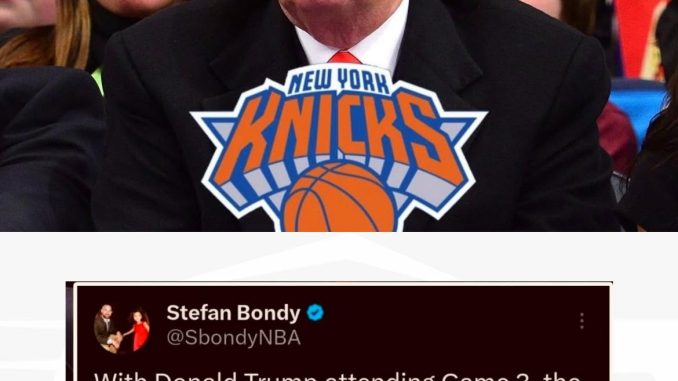
Game 3 of the NBA Finals between the New York Knicks and San Antonio Spurs was already shaping up to be one of the most highly anticipated sporting events of the year, but the atmosphere surrounding the matchup has now taken on an added layer of intensity off the court. With former U.S. President Donald Trump expected to be in attendance at Madison Square Garden, security measures have been significantly heightened, triggering a sweeping set of entry protocols that will directly affect thousands of fans heading into the arena.
According to multiple reports surrounding the event’s planning, the Knicks organization, in coordination with the Secret Service and arena security officials, have implemented a strict no-bag policy for all spectators entering the building. The move is part of a broader effort to streamline security screening and reduce congestion at entry points, as officials prepare for one of the most heavily monitored NBA Finals games in recent memory.
Fans attending Game 3 have also been strongly advised to arrive at least two hours before tipoff, with enhanced TSA-style screening procedures expected to be in full effect outside Madison Square Garden. The changes are designed to ensure maximum safety and efficiency given the scale of the event, the presence of high-profile individuals, and the already heightened stakes of a Finals series that has captured national attention.
While NBA Finals games routinely attract major celebrities, political figures, and global attention, the anticipated presence of a former president introduces an additional layer of security complexity. Secret Service involvement typically requires expanded perimeters, advanced screening checkpoints, and increased coordination with local law enforcement and venue security teams. In this case, that coordination appears to have translated into one of the most restrictive entry environments ever seen for a Knicks home game.
For fans, the impact will be immediate and unavoidable. Bags of any size — including backpacks, purses, tote bags, and potentially even small clutches — are expected to be prohibited from entry. Attendees are being urged to carry only essential items such as phones, wallets, and keys, and to prepare for extended wait times at security checkpoints. The expectation is that screening procedures will mirror airport-level protocols, with metal detectors, wand searches, and bag inspection stations replaced entirely by simplified but more intensive personal screening lanes.
The Knicks organization has not publicly detailed every operational aspect of the security plan, but the message to fans has been clear: arrive early, travel light, and expect delays. Arena officials are reportedly coordinating with the NBA and federal security agencies to ensure that entry flow remains controlled without compromising the fan experience or delaying the scheduled tipoff.
The development has quickly become one of the most discussed off-court storylines of the Finals, adding yet another dimension to a series already defined by drama, momentum swings, and high-stakes basketball. New York leads the series 2–0 heading into Game 3, placing additional pressure on the Spurs as they attempt to regroup on hostile territory at Madison Square Garden. But instead of focusing solely on the tactical chess match between the two teams, much of the pregame conversation has shifted toward logistics, security, and crowd management.
Inside the Knicks organization, Game 3 represents a pivotal opportunity. A 3–0 series lead would place New York on the brink of a championship and intensify the pressure on San Antonio to respond in what would effectively become a must-win Game 4 scenario. The presence of a politically charged figure in the building, however, adds an unpredictable variable to what is already a high-pressure environment.
Security experts note that events involving former presidents typically require coordination across multiple federal and local agencies, particularly in venues as densely populated and symbolically significant as Madison Square Garden. The arena, located in the heart of Manhattan, presents unique logistical challenges even under normal circumstances. Add an NBA Finals crowd, celebrity attendees, international media presence, and heightened political visibility, and the result is a security operation of exceptional scale.
The Knicks and Garden officials are no strangers to high-profile events. The venue has hosted everything from championship boxing matches to presidential visits and major cultural gatherings. Still, NBA Finals basketball presents a distinct challenge because of the volume of fans arriving in tight time windows, the emotional energy of the crowd, and the fixed schedule of professional sports broadcasts that leaves little room for delays.
For many fans, the most noticeable change will be the elimination of bags entirely. This policy alone is expected to alter how spectators prepare for the game. In previous Finals games, attendees typically arrive with merchandise purchases, food items, or personal belongings stored in small bags. Under the new policy, those routines will need to change dramatically. Some fans may choose to arrive with minimal belongings, while others could opt to store items off-site or at home before entering the arena.
Transportation authorities are also expected to feel the ripple effects. With fans being advised to arrive at least two hours early, increased foot traffic around Penn Station, subway entrances, and surrounding Midtown Manhattan streets is anticipated well before tipoff. Local businesses in the vicinity of Madison Square Garden could see earlier-than-usual crowds as fans adjust their schedules to comply with the stricter entry timeline.
From a basketball perspective, Game 3 remains a critical turning point in the series. The Knicks have capitalized on home-court advantage early, taking the first two games with disciplined defense and timely scoring runs that have left the Spurs searching for answers. San Antonio, meanwhile, enters the matchup under pressure but not without belief, knowing that a single road victory could shift momentum back in their favor.
Still, the conversation around the game has increasingly blurred the line between sports spectacle and national security event. The NBA has long embraced its status as a global entertainment product, regularly welcoming high-profile guests courtside. However, the intersection of politics, security protocol, and championship basketball creates a unique environment where the game itself becomes only part of the larger narrative.
Inside league circles, there is an awareness that such circumstances, while uncommon, are not unprecedented. High-profile political attendance at major sporting events has historically required similar security adjustments, though rarely at the intensity expected for a Finals game in New York City. League officials are said to be working closely with arena security to ensure that the competitive integrity of the game remains unaffected despite the external complexities.
Players, for their part, are expected to largely tune out the off-court noise. Coaches and team staff typically emphasize routine and focus during Finals preparation, especially in environments where external distractions can easily dominate headlines. Still, the energy inside Madison Square Garden is expected to be unlike anything seen so far in the series, with a packed crowd, heightened anticipation, and the added weight of national attention converging on one of basketball’s most iconic stages.
Fans who have attended previous Knicks postseason games at the Garden are familiar with the intensity of the atmosphere, but Game 3 is poised to elevate that experience into something even more controlled and tightly managed. The balance between maintaining a vibrant playoff environment and enforcing strict security protocols will be one of the key operational challenges of the night.
As tipoff approaches, attention will inevitably return to the court, where the Knicks aim to take a commanding stranglehold on the series and the Spurs fight to avoid falling into a near-insurmountable deficit. But before a single basketball is bounced, the scene outside the arena will already reflect the magnitude of the moment — long lines, early arrivals, heightened security presence, and a fanbase adjusting in real time to one of the most unusual pregame environments the NBA Finals has seen in years.
In a league accustomed to spectacle, Game 3 is set to deliver a different kind of drama before the opening whistle even sounds.
Be the first to comment