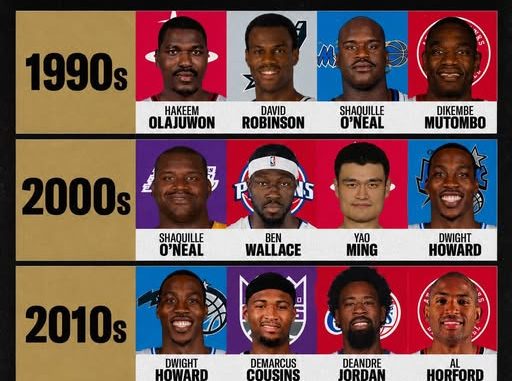
The debate over the greatest era of dominant big men is one of the most enduring arguments in NBA discourse, a conversation that stretches across generations and refuses to settle into a clean answer. Each decade has delivered its own archetype of interior dominance, from bruising paint enforcers and shot-altering rim protectors to modern-day seven-foot playmakers who bend offensive systems around their passing vision and perimeter skill. Whether it is the raw physical intimidation of the 1990s, the dual-post supremacy of the 2000s, the versatility revolution of the 2010s, or the positionless evolution of the 2020s, every era has produced giants who shaped championships and redefined what it means to control the game from the inside out.
The 1990s remain the foundation of modern big-man lore, a decade where interior play was not just a feature of basketball but its defining identity. It was an era carved out by bruising post battles, defensive walls in the paint, and footwork artistry that felt almost lost in today’s spacing-heavy game. At the center of it all stood Hakeem Olajuwon, whose “Dream Shake” became the gold standard for post technique, blending finesse, timing, and defensive genius in a way few have ever matched. Alongside him, Shaquille O’Neal began his ascent, using sheer force of nature to overwhelm opposing defenses, bending backboards and game plans alike. The era also featured pillars like Patrick Ewing, David Robinson, Dikembe Mutombo, and Alonzo Mourning, forming a defensive ecosystem where every trip to the rim felt like entering contested airspace. What made the 1990s special was not just individual greatness but the density of elite centers—multiple Hall of Fame-caliber big men competing nightly in a league that demanded interior dominance as a prerequisite for contention.
If the 1990s were about artistry and defensive warfare in the paint, the 2000s elevated big-man dominance into a championship engine that defined dynasties. This was the decade where size and power merged with refined skill sets, and where the most successful teams were often anchored by unstoppable forces in the post. Shaquille O’Neal reached his peak during this period, particularly with the Los Angeles Lakers, where his combination of strength, agility, and touch made him nearly unguardable in one-on-one situations. His dominance forced entire playoff defenses to collapse inward, opening perimeter opportunities that fueled championship runs. At the same time, Tim Duncan quietly built one of the greatest resumes in basketball history, operating as both power forward and center while anchoring the San Antonio Spurs’ disciplined, system-driven dynasty. Duncan’s fundamental precision, bank-shot mastery, and defensive positioning created a model of consistency that spanned nearly two decades. The decade also included the emergence of Kevin Garnett’s all-around brilliance, Yao Ming’s global impact, and Dwight Howard’s late-2000s defensive peak, when his athletic rim protection turned Orlando into a Finals team. The 2000s, more than any other era, were defined by championship-level big men who could both dominate individually and serve as the structural backbone of title-winning teams.
As the league transitioned into the late 2000s and early 2010s, the traditional role of the center began to evolve, even as dominant big men still controlled significant portions of the game. Defensive schemes adapted, offenses spaced the floor more aggressively, and big men were increasingly asked to defend in space rather than simply guard the paint. Yet even in this transitional period, elite interior forces continued to thrive. Dwight Howard’s defensive apex showcased the final form of the traditional athletic center, while players like Marc Gasol and DeMarcus Cousins demonstrated that passing and shooting were becoming essential additions to interior skill sets. At the same time, a new generation was beginning to form. Anthony Davis emerged as a prototype of the modern big man, combining shot-blocking instincts with perimeter mobility and offensive versatility. Nikola Jokic was still developing in relative obscurity, but early signs hinted at a passing genius unlike anything seen from a center. The 2010s represented a turning point: big men were no longer solely paint dwellers, but hybrid weapons being shaped for a faster, more perimeter-oriented league.
By the mid-to-late 2010s, the transformation was complete, and the definition of a dominant big man had expanded beyond traditional archetypes. Centers were now expected to facilitate offense, initiate transition plays, and stretch defenses to the three-point line. In this environment, Nikola Jokic emerged as a revolutionary force, redefining what a center could be by functioning as an offensive hub rather than a finishing point. His passing vision from the high post and beyond the arc turned Denver’s offense into a constantly shifting puzzle for defenses. At the same time, Joel Embiid introduced a blend of modern spacing with old-school physicality, dominating with footwork, mid-range scoring, and interior defense reminiscent of past eras. The 2010s also saw Anthony Davis evolve into one of the league’s most versatile defensive anchors, capable of guarding all five positions while still scoring at elite levels. While no single archetype dominated the decade in the way Shaq or Hakeem once did, the breadth of skill among big men reached unprecedented levels, making them more adaptable—and arguably more complete—than ever before.
The 2020s have taken this evolution even further, entering an era where big men are no longer confined to positional labels at all. The modern game has produced centers who operate as primary creators, defensive anchors who initiate fast breaks, and unicorn prospects who stretch the imagination of what is physically possible on a basketball court. Jokic has reached full dominance, winning multiple MVP awards and leading championship-caliber offenses through pure orchestration. Embiid continues to serve as a scoring machine in the post and mid-range, blending power and finesse in a way that still connects to past eras. Giannis Antetokounmpo, though often classified as a forward, functions as a modern interior force whose rim pressure and defensive versatility echo the dominance of past great centers. Meanwhile, the arrival of Victor Wembanyama has added an entirely new dimension to the conversation, as his combination of height, perimeter skill, and defensive range suggests a future where the concept of position itself may disappear entirely. The 2020s big man is no longer just a paint protector or post scorer, but a full-court problem solver capable of impacting every phase of the game.
When comparing eras, the debate ultimately comes down to what form of dominance is valued most: physical intimidation, championship impact, versatility, or innovation. The 1990s offered unmatched density of elite traditional centers, each capable of anchoring defenses and carrying offenses through the post. The 2000s delivered the clearest championship blueprint, where dominant big men directly translated into titles and dynasties. The 2010s expanded the skill set of big men beyond recognition, introducing passing, shooting, and defensive switchability as essential traits. The 2020s, meanwhile, have redefined the position entirely, turning centers into offensive engines and defensive schemers who operate across the entire court. Each era presents a different version of dominance, making cross-decade comparisons as much philosophical as statistical.
In the end, declaring a single greatest era depends on whether dominance is measured by physical control of the paint, championship execution, or evolutionary influence on the game itself. The 1990s may hold the crown for pure interior battles, the 2000s for championship-driven supremacy, the 2010s for skill expansion, and the 2020s for redefining basketball’s positional identity altogether. What remains undeniable, however, is that every era produced giants who did not just play the game but reshaped it. From Hakeem Olajuwon’s footwork mastery to Shaquille O’Neal’s overpowering force, from Tim Duncan’s quiet perfection to Nikola Jokic’s passing revolution and Victor Wembanyama’s emerging unicorn potential, the lineage of dominant big men continues to evolve without losing its central truth: championships are still built in the paint, even in an age that increasingly lives beyond it.
Be the first to comment