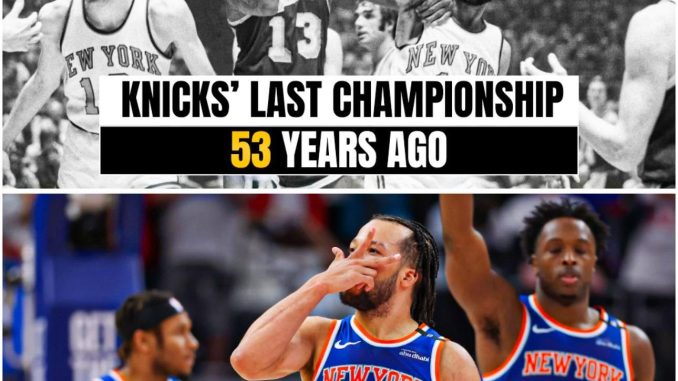
For more than five decades, the dream has lingered over New York City like an unfinished story waiting for its final chapter. Generations of fans have packed arenas, crowded sports bars, filled living rooms, and walked the streets of Manhattan, Brooklyn, Queens, the Bronx, and Staten Island hoping to witness the moment when the New York Knicks would once again stand at the top of the basketball world. Year after year, that dream has remained just out of reach. Now, after 53 years of frustration, heartbreak, rebuilding projects, near misses, and endless patience, the Knicks find themselves closer than they have been in a lifetime to bringing another NBA championship back to New York.
The franchise that last lifted the trophy in 1973 is now only two victories away from ending one of the longest championship droughts in professional sports. What once seemed like an impossible dream is suddenly becoming a realistic possibility, and the anticipation throughout the city continues to grow with every passing day.
For longtime supporters of the franchise, the significance of this moment cannot be overstated. The Knicks are not simply chasing another title. They are chasing history. They are chasing redemption. They are chasing a moment that would reconnect the present generation of players with the legendary teams that helped establish the franchise as one of basketball’s most iconic organizations.
The last championship banner raised by New York came during an era when basketball looked dramatically different. The roster was led by legends whose names remain permanently etched into franchise lore. Since then, the NBA has transformed through multiple generations, dynasties have risen and fallen, and countless stars have worn the Knicks uniform hoping to restore the franchise to glory.
Some came close. Many did not.
The 1990s produced several memorable playoff runs led by fierce competitors who embodied the city’s toughness and resilience. Those teams battled through some of the most physical and intense postseason series in league history, but championships remained elusive. Heartbreaking defeats became part of the franchise narrative. Whether it was narrow playoff exits, devastating injuries, or running into dominant opponents, the Knicks repeatedly found themselves falling just short of their ultimate goal.
The early 2000s brought instability and disappointment. Seasons often ended long before championship conversations could begin. Coaching changes, roster turnover, and front-office uncertainty left fans searching for reasons to believe that better days were ahead.
There were moments of hope. There were exciting players and memorable stretches. But sustained championship contention remained absent. For a franchise accustomed to occupying the center of the basketball universe, the drought grew heavier with every passing season.
As the years continued to pass, an entire generation of Knicks fans grew up without ever experiencing a championship celebration. Many had heard stories from parents and grandparents about the glory days but had never witnessed anything comparable themselves. The Larry O’Brien Trophy became something discussed in memories rather than reality.
Now, everything feels different.
This current Knicks team has reignited a belief throughout the city that many feared might never return. Built around a foundation of toughness, selflessness, and relentless effort, New York has emerged as one of the NBA’s most resilient groups. Rather than relying solely on star power, the Knicks have forged an identity centered on accountability, physicality, and an unwavering commitment to winning.
That approach has resonated deeply with a fan base that prides itself on grit and perseverance. New York sports fans have always appreciated teams willing to fight for every possession and embrace the pressure that comes with representing one of the world’s biggest markets. This Knicks squad has done exactly that.
Throughout the season and into the playoffs, the team has consistently demonstrated an ability to respond when challenged. Whether facing adversity during games, overcoming injuries, or navigating difficult postseason matchups, New York has repeatedly found answers when it mattered most.
The result is a franchise standing on the doorstep of history.
The atmosphere surrounding the city reflects the magnitude of the opportunity. Every game has become an event. Streets buzz with conversations about matchups and championship scenarios. Fans wearing blue and orange can be spotted everywhere, proudly displaying their belief that this could finally be the year.
Madison Square Garden, already considered one of sports’ most iconic venues, has transformed into an even more electric environment. Every possession carries enormous weight. Every basket generates deafening roars. Every defensive stop feels like a moment capable of altering the course of franchise history.
The Garden has always possessed a unique energy during meaningful basketball games, but the current excitement reaches another level. Many fans attending these contests understand they may be witnessing something their families have waited decades to see.
Outside the arena, anticipation continues to build. Restaurants, businesses, and neighborhoods across the city have embraced the playoff run. Knicks flags hang from apartment windows. Team apparel dominates sidewalks and subway platforms. Conversations that once centered on whether New York could become a contender have shifted toward how close the team is to completing its championship mission.
Yet despite the growing excitement, players and coaches understand that nothing has been accomplished yet.
Being two wins away from a title is both a remarkable achievement and a dangerous position. History is filled with teams that appeared destined for championship glory only to see opportunities slip away. The Knicks know that the final steps are often the most difficult.
Championships are not awarded based on potential celebrations. They are earned through execution, focus, and composure under pressure.
That reality has been a consistent message throughout the locker room. Players have emphasized the importance of remaining grounded and concentrating on the task directly in front of them. While fans understandably dream about parades and banners, the team continues to focus on individual possessions, defensive assignments, and game plans.
Such discipline has become one of New York’s defining characteristics.
Throughout the postseason, the Knicks have displayed a level of maturity that has impressed observers around the league. Emotional highs have not led to complacency. Disappointments have not created panic. Instead, the group has maintained a steady approach that reflects its collective confidence.
Veteran leadership has played a significant role in establishing that mindset. Experienced players understand the dangers of looking ahead and recognize how quickly playoff momentum can shift. Their ability to keep the team focused on immediate objectives has helped New York navigate the intense scrutiny that accompanies deep postseason success.
The coaching staff deserves significant credit as well. Establishing a culture capable of surviving the pressures associated with championship expectations requires consistency, trust, and accountability. The Knicks have demonstrated those qualities repeatedly throughout their journey.
Still, what makes this moment particularly meaningful is its connection to the city itself.
New York is unlike any other sports market in America. Expectations are enormous. Attention is constant. Success becomes legendary, while failure often receives equal attention. Few franchises carry the historical weight of the Knicks, and few fan bases have endured such a lengthy championship wait while remaining fiercely loyal.
Despite decades of disappointment, supporters never abandoned hope entirely. They continued showing up. They continued believing. They continued dreaming about the day when basketball’s biggest prize would return to New York.
That loyalty could soon be rewarded.
If the Knicks finish the job, the resulting celebration would likely become one of the most memorable moments in the city’s sports history. It is difficult to overstate the emotional impact a championship would have after a 53-year wait.
For older fans, it would represent the fulfillment of a dream they feared might never come true again. Some remember the last championship firsthand. Others have spent most of their lives waiting for another opportunity to celebrate.
For younger fans, the experience would be entirely new. They would finally understand what previous generations described when discussing championship basketball in New York.
Families would celebrate together. Friends would gather across the city. The championship would become more than a basketball accomplishment; it would become a shared cultural moment connecting generations of Knicks supporters.
The images would be unforgettable.
Crowds filling streets. Blue and orange dominating every corner of the city. Fans embracing strangers after years of collective frustration. A championship parade winding through New York with hundreds of thousands, perhaps even millions, celebrating the end of one of sports’ longest droughts.
The players themselves would instantly become part of franchise history.
Winning a championship in New York carries a unique significance. Great performances are remembered forever. Championship teams achieve a level of immortality rarely matched elsewhere. The current roster has an opportunity to secure a place alongside the most beloved figures ever associated with the organization.
That opportunity is what makes the next several games so significant.
Legacies are often determined by moments like these. Seasons can be remembered for years, but championships are remembered forever. The Knicks stand within reach of transforming an already remarkable campaign into one of the most celebrated achievements in franchise history.
Of course, the final hurdle remains substantial. Opponents do not simply surrender championships. Every remaining game will feature immense pressure, strategic adjustments, and emotional intensity. The margin between triumph and disappointment is often razor-thin at this stage of the postseason.
New York understands that reality.
The team’s success thus far has been built on respecting every challenge rather than assuming victory. That approach must continue if the championship dream is to become reality.
For now, though, hope continues to grow throughout the city.
After 53 years without an NBA title, the Knicks are closer than they have been in generations. They are only two victories away from ending decades of disappointment and bringing the Larry O’Brien Trophy back to the basketball capital of the world.
The journey is not finished. The hardest work still lies ahead. Yet for the first time in a very long time, Knicks fans can legitimately envision the moment they have spent half a century waiting to see.
The possibility is no longer distant. It is no longer theoretical. It is right in front of them.
Two more wins.
Two more victories separating New York from basketball immortality.
And if the Knicks can complete the mission, the celebration that follows may become one of the greatest sporting parties the city has ever witnessed—a championship moment generations have dreamed about, a trophy decades in the making, and the triumphant conclusion to a 53-year quest to bring NBA glory back where so many believe it belongs: New York City.
Be the first to comment