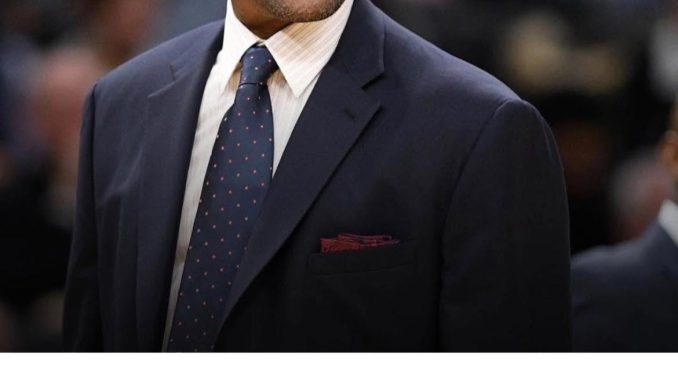
The New York Knicks have made a seismic mid-series adjustment in the NBA Finals, adding Hall of Famer Patrick Ewing to their coaching staff ahead of Game 3 as they look to counter the evolving tactical blueprint of the San Antonio Spurs and preserve their commanding series position.
In a move that immediately sent shockwaves through the league, the New York Knicks confirmed the addition of Ewing in a strategic advisory and front-line coaching role just days before Game 3 of the Finals against the San Antonio Spurs. The decision underscores both the urgency and seriousness of New York’s approach as the series shifts venues and as San Antonio attempts to claw its way back from a 2–0 deficit in the championship round.
The Knicks’ front office framed the move not as a symbolic reunion with one of the most iconic players in franchise history, but as a tactical necessity in response to what they describe internally as “rapid in-series evolution” from the Spurs’ coaching staff. San Antonio, despite trailing early in the series, has shown clear signs of adjustment through two games—tightening defensive coverages on New York’s primary scorers, altering pick-and-roll coverages, and increasing offensive pace in stretches where they’ve managed to generate separation.
For New York, the timing of Ewing’s arrival is as meaningful as the decision itself. The Knicks have already seized control of the series with back-to-back wins in Games 1 and 2, including a narrow, high-pressure 105–104 escape in Game 2 that highlighted both their resilience and their growing vulnerability when late-game execution tightens. While the scoreboard reflects dominance, internally the coaching staff has reportedly been increasingly aware that the Spurs’ adjustments are beginning to stress-test their defensive rotations and half-court offensive structure.
Ewing’s presence injects both institutional knowledge and a distinctive defensive philosophy into a staff already under pressure to anticipate San Antonio’s next move. A former Defensive Player of the Year candidate and the cornerstone of Knicks basketball during the 1990s, Ewing’s basketball identity is rooted in rim protection, physical interior defense, and disciplined rebounding positioning. Those qualities are expected to be central to New York’s Game 3 adjustments, particularly as San Antonio has begun to attack the paint with more frequency, forcing the Knicks’ bigs into foul trouble and creating rotation breakdowns off penetration.
Sources close to the organization describe Ewing’s role as “immediate-impact situational,” focusing on in-game defensive corrections, post coverage communication, and rebounding structure against the Spurs’ increasingly aggressive second-chance offensive sets. The Spurs have quietly improved their offensive rebounding rate through the first two games, a statistical shift that has not necessarily changed outcomes yet but has altered the flow of possessions and forced New York into extended defensive sequences.
That subtle pressure is exactly what San Antonio head coach Gregg Popovich’s system is designed to exploit: fatigue, hesitation, and defensive miscommunication. Through the first two games, the Spurs have used layered pick-and-roll actions and inverted spacing to drag New York’s rim protectors away from their comfort zones. When successful, those actions have produced either open corner threes or high-percentage cuts behind collapsing defenders.
The Knicks’ response in Game 3, therefore, is not simply about effort or intensity—it is about structural recalibration. Ewing’s familiarity with defensive anchoring in high-pressure playoff environments is expected to complement head coach Tom Thibodeau’s already rigid defensive schemes, especially in late-game scenarios where San Antonio has begun to generate more clean looks off broken coverage.
Inside the Knicks locker room, there is an acknowledgment that while the series lead is intact, the margin for error is narrowing. Game 1’s 105–95 victory was more comfortable on the scoreboard than in execution, with New York building its advantage through sustained defensive pressure and timely shot-making in the third quarter. Game 2, however, told a different story entirely. Despite another win, the Knicks were forced into a possession-by-possession grind that exposed lapses in transition defense and inconsistent spacing on offense.
The final sequence of Game 2, which saw New York narrowly escape with a 105–104 win, became a focal point in film sessions leading into Game 3 preparations. Multiple defensive breakdowns in the final two minutes allowed San Antonio to claw back from what had been a near double-digit deficit. Those possessions, according to team insiders, are precisely what prompted the front office to accelerate Ewing’s integration into the coaching structure.
From San Antonio’s perspective, the series is far from over. Despite the 0–2 hole, the Spurs have reason for optimism based on how effectively their adjustments have begun to take shape. Their defensive switching schemes have improved significantly between Game 1 and Game 2, and their offensive decision-making in transition has begun to reflect more confidence and fluidity. Where they struggled early with shot selection and spacing discipline, they have since found more rhythm through quicker ball movement and increased usage of secondary playmakers.
The challenge now for the Spurs is sustaining those adjustments over a full 48-minute game. Fatigue and execution lapses have proven costly, particularly in the fourth quarter where New York’s defensive discipline has tightened just enough to close out both contests. Still, within the Spurs’ camp, there is a belief that the series has not yet reflected their full tactical ceiling.
Ewing’s arrival adds another layer of complexity to that chess match. His reputation as a defensive anchor and his understanding of interior positioning may force San Antonio to further extend its offensive spacing, potentially increasing reliance on perimeter shooting. That shift could either open the floor for breakout performances from Spurs guards or expose them to the kind of cold shooting stretches that often define playoff momentum swings.
Beyond the tactical implications, the emotional weight of Ewing’s return to a Knicks bench role cannot be understated. For a franchise that has spent decades searching for sustained championship relevance, the presence of one of its most iconic figures on the sideline during an NBA Finals run carries both symbolic and psychological significance. While Ewing’s playing era never culminated in a championship for New York, his identity remains deeply intertwined with the city’s basketball culture and its expectations of toughness, discipline, and defensive pride.
That identity is precisely what the Knicks are attempting to reinforce at this stage of the Finals. As pressure mounts and margins shrink, organizations often turn to familiar voices and established philosophies to stabilize performance. In Ewing, the Knicks are not just adding a coach—they are reintroducing a mindset that prioritizes interior control, physical accountability, and defensive consistency.
The timing also reflects the increasingly adaptive nature of modern NBA Finals basketball. Coaching staffs are no longer static during series play; they evolve in real time, sometimes adding personnel or shifting responsibilities between games to counter emerging trends. New York’s decision to bring in Ewing ahead of Game 3 signals an acknowledgment that the Spurs’ adjustments have already forced a response, even if the scoreboard has not yet reflected a momentum shift.
For head coach Tom Thibodeau, the addition represents both support and escalation. Thibodeau’s defensive systems are among the most structured in the league, but the Spurs’ ability to probe gaps through movement and pace has required additional problem-solving layers. Ewing’s presence effectively adds another defensive mind to the equation, one with firsthand experience defending elite post play and operating in high-leverage playoff environments.
As Game 3 approaches, the series now enters its most unpredictable phase. Historically, a 2–0 lead in the NBA Finals places overwhelming pressure on the trailing team, but momentum in a series can shift quickly when tactical adjustments begin to land. The Spurs will look to capitalize on home court energy and continue accelerating their offensive tempo, while the Knicks aim to impose defensive stability and extend their series lead to a near-insurmountable 3–0 advantage.
What makes this development even more compelling is the psychological ripple effect. For New York, Ewing’s arrival reinforces belief and continuity. For San Antonio, it signals that their opponent is not content to simply ride early success—they are actively reinforcing their structure in anticipation of a counter-push.
Game 3, then, becomes more than just another Finals contest. It becomes a referendum on adaptation, coaching elasticity, and the ability of both teams to evolve under championship pressure. The Knicks are betting that experience, defensive discipline, and the reintroduction of a franchise legend can help them withstand San Antonio’s adjustments. The Spurs, meanwhile, are betting that their evolving system can finally break through the defensive wall New York has built through two games.
With Patrick Ewing now standing on the sideline, the stakes feel even heavier, the margins even thinner, and the chessboard even more complex. The Finals have officially entered their most tactical phase yet, and neither side appears willing to blink.
Be the first to comment