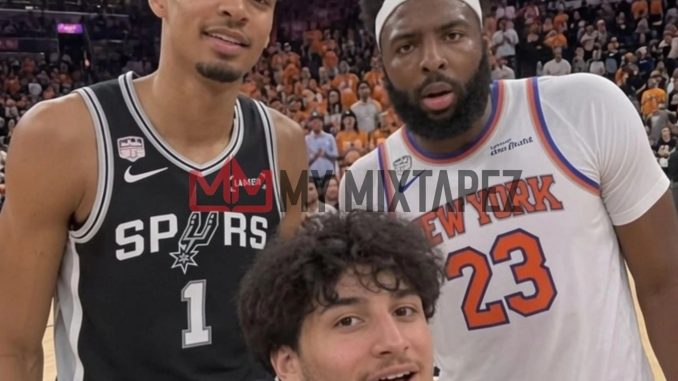
The fan who disrupted Game 1 of the 2026 NBA Finals by storming the court has been arrested and permanently banned from every NBA arena, league officials confirmed, bringing a swift conclusion to one of the most unusual moments of this year’s championship series between the New York Knicks and the San Antonio Spurs.
What was expected to be a night remembered solely for elite basketball instead briefly turned into a security concern when a spectator managed to breach arena barriers and enter the playing surface during the Finals opener. The incident immediately drew attention from players, coaches, security personnel, and fans both inside the arena and watching around the world, highlighting the challenges major sporting events continue to face when it comes to maintaining safety during high-profile competitions.
According to reports, security personnel reacted quickly once the individual entered the court, moving decisively to prevent any contact with players, coaches, referees, or team personnel. The interruption lasted only a short period before the fan was detained and removed from the floor, allowing play to resume. Although the disruption did not significantly affect the outcome of the contest, it instantly became one of the most talked-about moments surrounding Game 1.
League officials wasted little time in responding. The NBA confirmed that the individual responsible was taken into custody by law enforcement and has received a lifetime ban from all NBA arenas. The punishment represents one of the strongest disciplinary actions available to the league for spectator misconduct and underscores the seriousness with which the NBA views any unauthorized entry onto the playing surface.
The decision reflects a long-standing league policy that prioritizes the safety of everyone involved in NBA events. Players, coaches, officials, arena workers, and fans are all considered part of the protected environment that the league works to maintain. Any breach of that environment, particularly during the NBA Finals, is viewed as a major violation.
For athletes competing on basketball’s biggest stage, the incident served as an unwelcome distraction during what should have been a celebration of the sport. The Finals represent the culmination of an entire season’s worth of preparation, sacrifice, and competition. Players spend months battling through an 82-game regular season and multiple playoff rounds for the opportunity to compete for a championship. Any interruption, regardless of how brief, has the potential to disrupt focus and momentum.
Current and former players have often spoken about the importance of security during games. While most fans attend events to support their teams and enjoy the experience, isolated incidents involving court-storming spectators have periodically raised concerns throughout professional sports. Athletes frequently have little warning when a fan enters the playing area, creating uncertainty about the person’s intentions.
The NBA’s rapid response sends a clear message that such behavior will not be tolerated, particularly during the Finals when global attention is focused on the league. Millions of viewers tune in from around the world to watch the championship series, making security incidents especially visible and potentially damaging to the league’s image.
Historically, the NBA has consistently issued severe penalties for fans who cross boundaries between the seating areas and the playing surface. Lifetime bans have become increasingly common in cases involving dangerous or disruptive conduct, reflecting broader efforts across professional sports to strengthen venue security and protect participants.
The incident also reignited conversations about arena security procedures and the balance between creating an engaging fan experience and maintaining strict safety standards. Modern sports venues employ extensive security measures, including surveillance systems, credential checkpoints, security personnel stationed throughout arenas, and emergency response protocols designed to handle unexpected situations.
Despite those precautions, occasional breaches still occur, often drawing significant media attention because of their rarity. In many cases, leagues use such incidents as opportunities to review and refine existing security practices. While there has been no indication that anyone was harmed during the Game 1 disruption, the event will likely be studied closely by both the NBA and arena operators as part of ongoing evaluations.
For the players on the court, however, the focus quickly returned to basketball. The Finals opener featured two franchises seeking to add another memorable chapter to their histories. The Knicks entered the series aiming to capture a championship and build on a remarkable postseason run, while the Spurs continued their pursuit of another title in a season that has showcased the organization’s resurgence.
The unexpected interruption briefly shifted attention away from the action, but players appeared determined not to let the incident impact their performance. Once order was restored, the game continued and the championship atmosphere returned.
League officials emphasized that fan passion remains one of the NBA’s greatest strengths. The energy generated by sold-out arenas and enthusiastic supporters is a vital part of what makes the Finals such a special event. However, that passion must operate within established rules designed to ensure the safety and enjoyment of everyone in attendance.
The lifetime ban serves as both punishment and deterrent. By issuing the maximum penalty, the NBA is signaling that spectators who attempt similar actions in the future should expect severe consequences. Such measures are intended not only to address individual incidents but also to discourage copycat behavior at future games.
The legal consequences may prove equally significant. Depending on local laws and the specific circumstances surrounding the incident, individuals who enter restricted areas at sporting events can face criminal charges in addition to league-imposed sanctions. The fact that the fan was taken into custody immediately after the incident demonstrates the coordinated response between arena security and law enforcement personnel.
Security experts often note that high-profile sporting events require constant vigilance because of the large crowds and emotional intensity involved. Championship games, in particular, attract heightened attention, creating an environment where organizers must prepare for a wide range of scenarios. While the overwhelming majority of fans behave responsibly, even a single breach can become a major concern.
The NBA Finals have historically produced unforgettable moments, from championship-clinching performances to iconic celebrations. Rarely, however, do off-court incidents become part of the conversation. The court-storming episode from Game 1 now joins a small list of unusual events that temporarily diverted attention from the competition itself.
As the series moves forward, league officials hope the focus remains squarely on the players and the pursuit of the Larry O’Brien Trophy. Both teams have invested immense effort into reaching this stage, and the NBA’s swift disciplinary action appears designed to ensure that future headlines center on basketball rather than security concerns.
For fans attending upcoming Finals games, the message is unmistakable. The NBA welcomes passion, enthusiasm, and support, but crossing onto the court is a line that cannot be crossed. The league’s decision to impose a lifetime ban demonstrates its commitment to preserving a safe environment and protecting the integrity of its showcase event.
Ultimately, the story serves as a reminder of the unique challenges that accompany major sporting spectacles. The Finals bring together the best players in the world, enormous crowds, and global attention. Maintaining order within that environment requires cooperation among league officials, arena staff, security personnel, law enforcement, and fans themselves.
While Game 1 will be remembered primarily for the basketball played between the Knicks and Spurs, the spectator intrusion offered a stark example of how quickly an unexpected event can capture headlines. The NBA’s response was immediate and decisive: arrest, removal, and a permanent ban from every arena under the league’s umbrella.
With that matter now addressed, attention shifts back to the championship battle itself. The players, coaches, and fans who have invested so much in this Finals matchup can once again focus on what matters most—the pursuit of an NBA title. And after the league’s firm response, there is little doubt that anyone considering a similar stunt in the future has been put on notice that the consequences will be severe, lasting, and career-defining long after the final buzzer sounds.
Be the first to comment