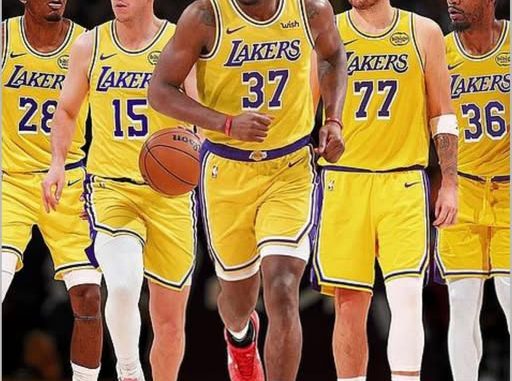
If the Los Angeles Lakers find themselves staring at a future without LeBron James, the franchise would not simply be losing a player—it would be closing a defining era of modern basketball. And in today’s NBA ecosystem, where contention windows are measured in microseconds and roster alignment is everything, the Lakers would be forced into an immediate recalibration of identity, structure, and ambition.
In that scenario, a growing line of league thinking suggests a bold, almost seismic pivot: if the Lakers are truly able to pair a generational engine like Luka Dončić with the right interior anchor, then going “all-in” on a young, explosive big like Jalen Duren becomes more than just an option—it becomes a blueprint.
The idea is rooted in a simple but powerful basketball truth: Luka Dončić thrives when he is surrounded by vertical pressure, rim-running force, and defensive coverage that frees him from overburdened responsibilities on both ends. For years, Luka has carried offensive systems that rely heavily on his isolation brilliance, pick-and-roll manipulation, and step-back shooting genius. But what he has rarely enjoyed is a consistent, elite-level lob threat paired with high-level interior mobility and defensive anchoring behind him.
That is where Duren enters the conversation with increasing seriousness.
At just 21 years old, Jalen Duren represents one of the most physically imposing young centers in the NBA. Built with rare strength, explosive leaping ability, and soft-touch finishing around the rim, he has already carved out a reputation as a nightly double-double threat for the Detroit Pistons. More importantly for a contender, Duren is not just a stat accumulator—he is a vertical spacer who warps defensive schemes simply by existing in the dunker spot or sprinting in transition lanes.
For a Lakers front office facing the theoretical post-LeBron landscape, the calculus becomes brutally simple: how do you maximize Luka Dončić’s prime years while simultaneously building a defensive identity that can survive the Western Conference’s evolving athletic arms race?
The answer, in this framework, begins with structure rather than star accumulation.
Historically, the Lakers have oscillated between star-driven roster construction and complementary depth building. The LeBron era itself was defined by pairing him with co-stars like Anthony Davis and shifting role players around elite shot creation. But if LeBron James were to move on, retire, or transition elsewhere, the Lakers would lose not just production, but also the gravitational leadership that stabilized their system.
That vacuum would demand a new architectural spine.
Enter Luka Dončić as the offensive hub, and Jalen Duren as the interior engine.
The pairing works because it solves multiple structural problems at once. Luka, by design, bends defenses with his pace manipulation, pick-and-roll mastery, and ability to punish switches. But defenses that load up on him in the playoffs often force him into isolation-heavy late possessions without reliable vertical threats to punish help defenders. Duren changes that dynamic immediately.
Imagine Luka walking the ball up, signaling a high pick-and-roll with Duren. The defense is already compromised. If the big defender drops, Luka has midrange control and pull-up threes. If he steps up, Duren becomes a rolling wrecking ball toward the rim. If the defense collapses from the weak side, Luka becomes a live-reads passer capable of threading lobs or skip passes to shooters.
It is not just synergy—it is pressure multiplication.
Duren’s offensive profile has quietly evolved into one of the more efficient young big-man arsenals in the league. He finishes at the rim at a high clip, thrives in transition, and has shown improved discipline in screening angles and offensive rebounding positioning. While he is not a perimeter shooter, his lack of spacing range is less relevant in a system where Luka Dončić naturally draws multiple defenders above the break.
The real transformation comes on defense.
The Lakers’ long-term contention viability has always depended on their ability to protect the rim without sacrificing perimeter mobility. Duren offers a rare blend of both. He is strong enough to hold position against traditional centers, quick enough to recover in pick-and-roll coverage, and explosive enough to erase mistakes at the rim. In a conference dominated by guards who weaponize switch hunting and downhill pressure, that combination is invaluable.
For Luka specifically, having a defensive anchor behind him is not a luxury—it is a necessity. One of the biggest criticisms of Luka-led teams in high-stakes playoff environments has been the defensive burden placed on him due to roster construction. Pairing him with a mobile interior protector like Duren allows a coaching staff to design schemes where Luka can conserve energy for offensive creation while trusting the backline to absorb pressure.
From a Lakers perspective, the roster fit also addresses a long-standing issue: rebounding and second-chance control. Duren is an elite offensive rebounder for his age and position, and his physicality immediately changes the tone of a game. Those extra possessions become critical in playoff environments where half-court execution tightens and every point is contested.
The strategic challenge, however, is acquisition cost.
The Detroit Pistons would not part with Jalen Duren lightly. He is part of a young core that the organization has been developing through years of rebuilding patience. Any Lakers offer would likely need to be substantial, potentially including multiple first-round picks, pick swaps, and young rotation players. For a franchise attempting to balance present contention with future flexibility, such a move would signal full commitment to a new era built around Luka Dončić.
And that is where the LeBron James transition becomes pivotal. If LeBron James were to leave the Lakers’ roster structure, the team would suddenly find itself with both urgency and flexibility—urgency to remain competitive, and flexibility to reshape the roster without the shadow of a win-now legend dictating every decision.
In that environment, a Luka-Duren foundation becomes not just plausible but strategically coherent.
Critics of the idea will point to spacing limitations. Duren does not stretch the floor, and in modern NBA theory, non-shooting bigs can be exploited in playoff schemes that pack the paint. But that argument loses weight when the primary engine is Luka Dončić, one of the most effective pick-and-roll playmakers in basketball history. Luka’s gravity alters defensive geometry in a way that compensates for traditional spacing weaknesses.
Furthermore, the Lakers could surround the duo with shooting-heavy wings and guards, creating a roster balance where Duren’s interior presence is offset by perimeter spacing from complementary role players. The key is not uniform spacing across all five positions, but functional spacing that allows Luka to operate in optimal zones while Duren punishes overhelping defenses.
There is also the developmental upside that makes this pairing particularly intriguing. Duren is not a finished product. His offensive reads, passing out of short rolls, and defensive communication continue to improve. Under a high-IQ offensive system led by Luka Dončić, his growth curve could accelerate significantly. Few young centers in the league would benefit more from elite guard orchestration than Duren.
From a macro franchise standpoint, the Lakers’ pursuit of such a player would represent a philosophical shift. Instead of chasing aging stars or short-term fixes, they would be investing in a long-term dual-core structure that could theoretically anchor the franchise for the next decade.
There are, of course, alternative paths. The Lakers could pursue stretch bigs, veteran rim protectors, or even more perimeter-heavy constructions. But few options combine age, athletic ceiling, defensive versatility, and offensive efficiency at the rim the way Duren does.
The comparison that often emerges in league circles is less about direct player archetypes and more about system compatibility. Luka Dončić has historically elevated rim-running bigs to career-best production. Whether it was lob threats, rolling centers, or vertical finishers, his ability to manipulate defensive attention consistently creates easy scoring opportunities for interior players. Duren fits that mold with added defensive upside.
In a Western Conference landscape increasingly defined by speed, physicality, and multi-positional threats, the Lakers would need a center who can survive switching actions, protect the paint, and still finish at a high level in transition. Duren checks those boxes more convincingly than most available young bigs.
Ultimately, the premise of the Lakers going “all-in” on Jalen Duren hinges on one central question: what does post-LeBron identity look like for a franchise that has long relied on generational stars to define its competitive window?
If the answer involves building around Luka Dončić as the offensive nucleus, then investing heavily in a high-motor, rim-running, defensively versatile center becomes less of a speculative gamble and more of a structural necessity.
In that vision, Duren is not simply a trade target. He becomes the connective tissue between star creation and sustainable team balance—a player whose impact may not dominate highlight reels in isolation, but whose presence quietly determines whether a Luka-led Lakers team is merely competitive or truly championship-caliber.
And in the modern NBA, where margins define legacies, that distinction is everything.
Be the first to comment