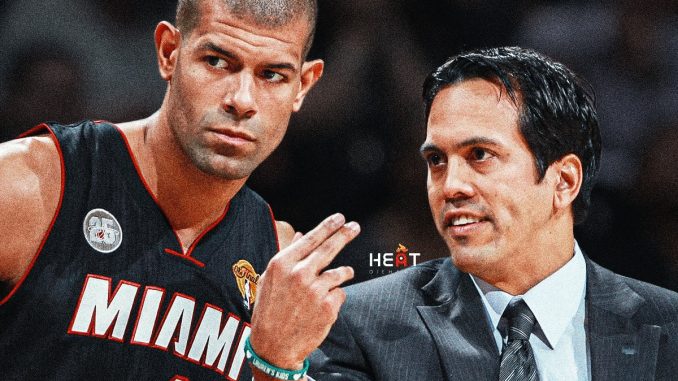
For years, the Miami Heat dynasty was defined by star power, championship banners, and unforgettable playoff moments. The spotlight naturally belonged to LeBron James, Dwyane Wade, and Chris Bosh — the celebrated “Big Three” that transformed Miami into basketball’s center of gravity during the early 2010s. But according to former Heat guard Mario Chalmers, the true intellectual architect behind much of the team’s defensive brilliance was a player who rarely commanded headlines or dominated highlight reels.
That player was Shane Battier.
Speaking candidly about the inner workings of Miami’s championship culture, Chalmers offered high praise for Battier’s basketball intelligence and preparation, calling him “the brains of the operation” during the Heat’s dominant run to four straight NBA Finals appearances and back-to-back championships in 2012 and 2013.
For fans who watched the Heat during that era, Battier’s impact was often subtle but unmistakable. He was rarely the leading scorer. He was not the franchise face. Yet coaches trusted him in virtually every crucial moment, and teammates leaned heavily on his understanding of defensive coverages, scouting reports, spacing, and situational basketball. Chalmers’ comments pull back the curtain on just how influential Battier truly was behind the scenes.
During Miami’s championship years, the Heat became known for an aggressive, versatile defensive identity that suffocated opponents in critical moments. Their ability to switch assignments, trap ball handlers, rotate seamlessly, and communicate under pressure helped separate them from the rest of the league. While head coach Erik Spoelstra designed the overall schemes, players like Battier became extensions of the coaching staff on the floor.
Chalmers explained that Battier constantly studied tendencies and prepared for every possible matchup detail long before tipoff. Whether Miami was facing elite scorers in the Eastern Conference playoffs or battling Western Conference powers in the Finals, Battier reportedly entered games armed with precise knowledge of opponents’ habits, favorite moves, and shooting locations.
That preparation helped Miami execute defensive game plans with remarkable discipline. Battier was known league-wide as one of basketball’s smartest defenders, capable of guarding multiple positions despite lacking elite athleticism compared to many of the stars he faced nightly. He compensated with anticipation, positioning, communication, and relentless film study.
In many ways, Battier symbolized what made those Heat teams so difficult to beat. While the public focused on explosive dunks, fast breaks, and superstar scoring runs, Miami’s championship foundation often rested on defensive execution and sacrifice. Battier embraced every thankless responsibility imaginable. He guarded the opponent’s best wing scorer, took charges, spaced the floor offensively, and consistently made the extra pass.
For Chalmers, who spent several seasons sharing the backcourt with some of the NBA’s brightest stars, Battier’s influence extended far beyond his box-score numbers. The former point guard suggested that Battier essentially functioned as an on-court strategist, helping teammates anticipate actions before they happened.
That role became especially important during postseason basketball, where adjustments often determine championships. Opposing teams spent entire playoff series attempting to exploit mismatches or target weaknesses, but Miami’s veteran intelligence repeatedly neutralized those efforts. Battier’s communication reportedly helped keep the Heat organized in chaotic moments, particularly when Miami deployed its smaller, faster lineups that revolutionized modern NBA basketball.
The Heat’s “small-ball” units changed the league forever. With Bosh often playing center and James operating as a point-forward capable of defending nearly every position, Miami forced opponents into uncomfortable matchups. Battier became one of the glue pieces that made those lineups function at an elite level. He understood spacing offensively and defensive rotations instinctively, allowing the Heat to play at a blistering pace without losing structural discipline.
Many NBA observers now look back on those Miami teams as early pioneers of the positionless basketball that dominates today’s league. Battier’s versatility was central to that evolution. He could defend guards, wings, and stretch forwards while also knocking down timely three-pointers offensively. His IQ allowed Miami to maximize its superstar talent without sacrificing chemistry or balance.
Chalmers’ remarks also highlight an important truth about championship basketball: dynasties are rarely sustained by stars alone. Every elite team features role players whose impact extends beyond public recognition. Battier fit that description perfectly.
Before arriving in Miami, Battier had already built a reputation as one of the NBA’s consummate professionals during his time with the Memphis Grizzlies and Houston Rockets. Coaches and analysts routinely praised his intelligence, leadership, and professionalism. Advanced metrics often adored his impact even when traditional statistics did not fully capture it.
Former teammates across the league consistently described Battier as one of the smartest players they had ever encountered. His approach to preparation reportedly bordered on obsessive. He famously studied analytics before many players fully embraced them and paid attention to detailed tendencies that most defenders ignored.
That meticulous preparation paid enormous dividends during Miami’s deepest playoff battles.
In the 2012 NBA Finals against the Oklahoma City Thunder, Battier delivered one of the best shooting stretches of his career while simultaneously helping defend elite scorers like Kevin Durant. His timely perimeter shooting punished defenses for collapsing on James and Wade, and his composure under pressure stabilized Miami throughout the series.
A year later, during the unforgettable 2013 Finals against the San Antonio Spurs, Battier again proved invaluable. While Ray Allen’s iconic Game 6 three-pointer remains immortalized in NBA history, Battier quietly produced a huge performance of his own in Game 7, scoring 18 points and knocking down six three-pointers in Miami’s championship-clinching victory.
Those moments reinforced what teammates already understood internally: Battier consistently delivered when winning basketball mattered most.
Chalmers’ comments may resonate especially strongly because he experienced the Heat dynasty from the inside. As Miami’s starting point guard during those championship seasons, Chalmers had a front-row seat to the daily preparation, locker room dynamics, and tactical conversations that fueled the organization’s success.
His perspective carries weight because it moves beyond surface-level analysis. Fans saw Battier as a valuable role player. Chalmers saw him as a strategic mastermind whose influence shaped the team’s defensive mentality every single day.
That distinction matters when evaluating championship teams historically. Basketball history often centers on superstars, but players inside those locker rooms usually understand how critical complementary pieces truly are. Championship chemistry depends on trust, sacrifice, and basketball intelligence as much as raw talent.
Battier embodied those traits.
The former Duke standout built an NBA career not on overwhelming physical gifts, but on maximizing every intangible element of the game. He defended without fouling, rotated precisely, boxed out bigger players, and consistently made smart decisions under pressure. Coaches trusted him because he rarely beat himself mentally.
In today’s NBA, where offensive explosions dominate headlines and scoring numbers soar nightly, Battier’s style serves as a reminder that elite defense still requires extraordinary intellect and discipline. He studied angles, tendencies, and timing with the precision of a coach. Chalmers’ praise underscores how valuable that expertise became within Miami’s championship infrastructure.
Battier also brought emotional stability to a roster constantly under immense scrutiny. The Heatles era generated relentless media attention, criticism, and expectations. Every losing streak became national news. Every playoff game carried enormous pressure. Veteran voices like Battier helped keep the locker room grounded amid that chaos.
His professionalism reportedly influenced younger players throughout the organization, including Chalmers himself. While Chalmers often played with fiery emotion and confidence, Battier’s calm analytical mindset balanced the group.
That combination helped Miami survive numerous playoff tests.
The Heat faced bitter postseason rivalries against teams like the Boston Celtics, Indiana Pacers, and Spurs during their Finals runs. Those series frequently turned into physical, mentally exhausting battles where preparation and adjustments became critical. Battier’s basketball mind reportedly helped Miami stay one step ahead in many of those confrontations.
His ability to interpret game flow in real time also gave the Heat a competitive advantage. Great defenders rarely rely solely on reaction. They anticipate. Battier excelled at reading actions before they fully developed, allowing him to disrupt passing lanes, force difficult shots, and position teammates correctly.
That kind of intelligence rarely trends on social media or dominates television debates, but inside championship organizations, it becomes priceless.
Chalmers’ reflections arrive at a time when many former players have started sharing deeper stories about the inner workings of iconic teams. Fans increasingly want to understand not just who scored the most points, but how dynasties actually functioned behind closed doors. Insights like Chalmers’ help paint a fuller picture of the Heat’s success.
It also reinforces Battier’s legacy within NBA history.
Though he was never a perennial All-Star or statistical superstar, Battier earned enormous respect from coaches, executives, and fellow players throughout his career. He became the prototype for the modern championship role player — versatile defensively, intelligent offensively, emotionally mature, and fully committed to team success.
His influence can still be seen across today’s league. Nearly every contender now searches for “3-and-D” wings who can defend multiple positions and stretch the floor offensively. Battier helped define that archetype before it became one of basketball’s most coveted player profiles.
For Miami fans, Chalmers’ comments may simply confirm what they long suspected. Battier’s fingerprints were all over the franchise’s golden era.
Even years after those championship banners were raised, the respect former teammates continue showing Battier speaks volumes about his impact. Superstars may define eras publicly, but championship cultures are often sustained by players willing to master the smallest details. Battier made a career out of owning those details.
As the NBA continues evolving toward pace, spacing, and versatility, the value of high-IQ role players has only grown more apparent. Battier was ahead of his time in many respects, blending analytics, adaptability, and defensive communication into a winning formula that helped shape the modern game.
Chalmers’ statement — “He was the brains of the operation” — may ultimately become one of the most revealing descriptions of the Heat dynasty ever offered by an insider. It captures the reality that basketball greatness is rarely achieved through talent alone. Intelligence, preparation, and selflessness remain essential ingredients for championship success.
And during one of the NBA’s most memorable dynasties, few embodied those qualities better than Shane Battier.
Be the first to comment