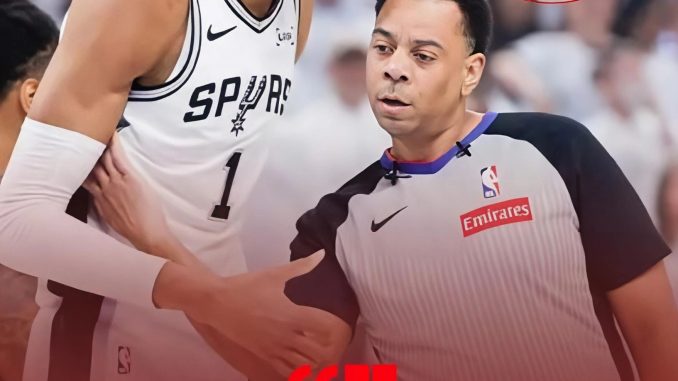
The debate surrounding officiating in the NBA playoffs has once again taken center stage, and this time the spotlight has landed squarely on Shai Gilgeous-Alexander and the Oklahoma City Thunder. As tensions continue to rise during an emotionally charged Western Conference Finals battle against the San Antonio Spurs, accusations from fans, analysts, and even former players have intensified regarding what many believe to be a favorable whistle for the Thunder superstar. Gilgeous-Alexander, however, has made it clear that he strongly disagrees with that narrative.
Following another bruising postseason contest that reignited discussions about foul calls and officiating consistency, Gilgeous-Alexander addressed the criticism head-on, insisting that the referees have handled the series fairly and without bias. The MVP candidate dismissed claims that he receives preferential treatment from officials, arguing instead that his style of play naturally creates contact situations that force defenders into difficult positions.
For weeks, the discourse surrounding the Thunder’s playoff run has revolved around physicality, free throws, and officiating balance. Opposing fan bases have repeatedly pointed to Gilgeous-Alexander’s ability to draw fouls at key moments as evidence that Oklahoma City benefits from a softer whistle than its opponents. Social media erupted again after the latest game in the series, with clips circulating online showing disputed calls involving drives to the rim, mid-range pull-ups, and late-game possessions where defenders appeared frustrated by the decisions going against them.
But Gilgeous-Alexander showed little interest in entertaining those complaints. Calm and composed during his postgame media availability, the Thunder guard emphasized that playoff basketball is naturally physical and that officials are simply making the calls they see in real time. According to Gilgeous-Alexander, there has been no imbalance in the officiating throughout the series, despite the growing noise surrounding it.
The Thunder star explained that he never enters games expecting favorable treatment from referees. Instead, he focuses on remaining aggressive offensively, attacking the paint, and putting defenders in compromising situations. That aggression, he noted, inevitably leads to contact. From his perspective, the foul calls being awarded are a product of his offensive approach rather than special treatment.
It is not the first time Gilgeous-Alexander has faced accusations about officiating during his rise into superstardom. Over the past two seasons, the dynamic guard has become one of the NBA’s premier scorers largely because of his elite ability to manipulate defenses. His hesitation dribbles, changes of pace, and long strides make him extraordinarily difficult to guard without fouling. Defenders often find themselves off balance as he slithers into the lane or abruptly stops for his deadly mid-range jumper.
Those same skills, however, have also made him a polarizing figure among rival fans. Critics argue that modern NBA officiating rewards offensive players too heavily and that Gilgeous-Alexander has mastered exploiting those tendencies. Supporters counter that elite scorers throughout league history — from Michael Jordan to Kobe Bryant to James Harden — consistently generated free throws because defenders struggled to contain them legally.
The timing of the controversy has only amplified the scrutiny. The Thunder and Spurs have developed one of the most physical and emotionally intense playoff rivalries of the postseason, with every possession carrying enormous weight. Tempers have flared repeatedly throughout the series, especially as Victor Wembanyama and San Antonio’s defense have attempted to disrupt Oklahoma City’s rhythm by increasing the physicality on drives and forcing the Thunder into uncomfortable half-court possessions.
Game 6 in particular intensified the debate. San Antonio delivered a dominant performance to force a decisive Game 7, overwhelming Oklahoma City with relentless defense and superior energy from the opening tip. The Spurs appeared determined to send a message physically, challenging every drive, contesting every cut, and ensuring that no Thunder player received easy scoring opportunities.
As frustration mounted for Oklahoma City during the loss, conversations immediately shifted toward officiating afterward. Some observers claimed the Thunder were finally receiving the same physical treatment they had benefited from earlier in the series. Others argued that the officiating crew allowed excessive contact on both sides. Gilgeous-Alexander, however, refused to suggest that the referees influenced the outcome.
Instead, he credited San Antonio for playing harder and executing better. He acknowledged that playoff basketball demands adjustments from game to game and emphasized that officiating should never become an excuse for poor performance. That mindset has become a defining characteristic of Gilgeous-Alexander’s leadership during Oklahoma City’s rapid ascent from rebuilding franchise to championship contender.
Inside the Thunder locker room, there appears to be little concern about the public narrative surrounding officiating. Players and coaches have consistently preached discipline, composure, and focus throughout the postseason. Head coach Mark Daigneault has repeatedly praised his team’s maturity, particularly under the intense spotlight that accompanies deep playoff runs.
That maturity has been tested repeatedly in this series. Nearly every game has featured controversial moments, hard fouls, emotional reactions, and heated online debates afterward. Yet the Thunder have largely avoided public criticism of officials, even after difficult losses. Gilgeous-Alexander’s latest comments continued that trend, reinforcing the organization’s emphasis on accountability rather than blame.
Still, the conversation surrounding officiating is unlikely to disappear anytime soon. The NBA has long battled accusations of inconsistency in foul calls, particularly during the postseason when physicality traditionally increases. Fans often struggle to understand why certain contact is allowed in one quarter but penalized in another, or why star players sometimes appear to receive different treatment than role players.
Gilgeous-Alexander’s prominence only magnifies that reality. Superstars inevitably attract more scrutiny because they dominate the ball and dictate the flow of games. Every whistle involving a player of his caliber becomes magnified under the playoff microscope, especially when championships are at stake.
What makes Gilgeous-Alexander especially difficult to officiate is the unique nature of his offensive game. Unlike explosive dunkers who rely primarily on brute force, he thrives through timing, angles, footwork, and deception. Defenders often initiate contact because they are reacting late to his movements. On many possessions, he appears to glide rather than sprint, patiently waiting for defenders to make mistakes before attacking.
That style creates a constant challenge for officials attempting to determine legal guarding position in real time. Slight reaches, hip contact, or disrupted shooting motions can all result in fouls depending on the angle and timing. While opposing fans may interpret those whistles as favoritism, coaches and scouts often describe them as the inevitable consequence of guarding elite creators.
The numbers themselves have also fueled debate throughout the playoffs. Oklahoma City has consistently ranked among the league leaders in drives per game, while Gilgeous-Alexander remains one of basketball’s most aggressive paint attackers despite not relying on overwhelming athleticism. Analytics experts frequently note that players who attack the rim relentlessly tend to draw more fouls by sheer volume alone.
San Antonio, meanwhile, has embraced an increasingly physical defensive approach as the series has progressed. Veteran defenders have crowded driving lanes, contested shots with greater force, and attempted to disrupt Oklahoma City’s offensive flow through contact. Spurs players have also publicly stressed the importance of matching the Thunder’s intensity possession by possession.
That strategic adjustment contributed heavily to the dramatic turnaround in Game 6, where San Antonio controlled the pace and imposed its preferred style of basketball from start to finish.
The looming Game 7 now promises to become one of the defining moments of the NBA postseason. With a trip to the NBA Finals on the line, every call, every possession, and every decision by the officiating crew will face microscopic scrutiny. Fans from both sides are already bracing for another wave of controversy regardless of the outcome.
For Gilgeous-Alexander, however, the focus remains squarely on basketball. His comments reflected a player unwilling to become distracted by narratives surrounding referees or public perception. He repeatedly emphasized execution, discipline, and competitiveness rather than whistles or officiating theories.
That mentality has been central to Oklahoma City’s identity all season. The Thunder built their success on resilience, defensive intensity, and collective confidence despite being one of the NBA’s youngest contenders. Gilgeous-Alexander has served as the emotional anchor throughout that rise, combining elite production with a calm demeanor that stabilizes the locker room during high-pressure moments.
Even critics acknowledge his brilliance as a player. Whether fans love or hate the whistles he receives, few dispute his extraordinary skill level. Gilgeous-Alexander has evolved into one of basketball’s most complete offensive weapons, capable of controlling games through scoring, playmaking, tempo, and clutch shot-making. His playoff performances have further solidified his place among the league’s elite superstars.
The broader officiating debate surrounding him also reflects a larger conversation about the modern NBA itself. As offensive creativity continues evolving, referees face increasingly difficult challenges balancing freedom of movement with defensive physicality. Every postseason reignites discussions about what should or should not constitute a foul, particularly when star players attack relentlessly.
Some former players argue the league has become too offense-friendly. Others believe defenders simply must adapt to increasingly skilled scorers. Gilgeous-Alexander’s situation exists directly at the center of that debate, making him one of the most discussed figures of the playoffs.
Yet amid all the controversy, the Thunder star remains unwavering in his position: the officiating has been fair.
Whether fans agree or disagree, his comments demonstrated confidence, composure, and an unwillingness to shift responsibility elsewhere. In an era where athletes often publicly criticize referees after difficult losses, Gilgeous-Alexander instead chose restraint. He acknowledged the physical nature of the series, respected the challenge posed by San Antonio, and maintained that officials were doing their jobs to the best of their ability.
Now the basketball world turns its attention toward a winner-take-all showdown between Oklahoma City and San Antonio. The stakes could not be higher. A trip to the Finals awaits the victor, while the loser will spend the offseason replaying every missed opportunity, every possession, and inevitably, every controversial whistle.
And as the tension rises ahead of Game 7, one thing is certain: every call involving Shai Gilgeous-Alexander will once again be analyzed, debated, celebrated, and criticized in real time.
Be the first to comment