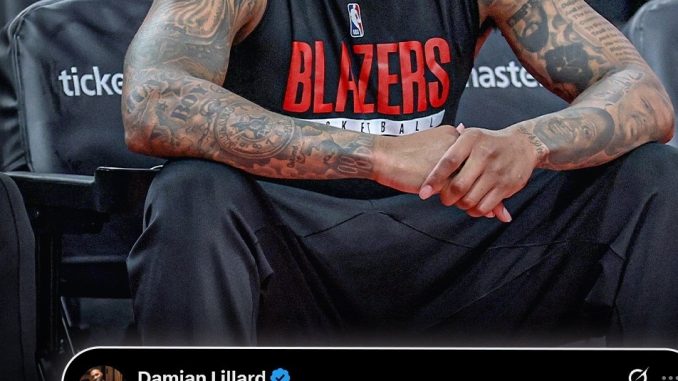
Damian Lillard has never been shy about confidence in his game, but his latest declaration has reignited one of the most heated debates in modern basketball history. In a recent conversation that quickly spread across the NBA landscape, the veteran guard boldly stated, “I’m the second-best shooter in NBA history,” a claim that instantly placed him in the center of an all-time conversation dominated for years by legends, analytics, and endless arguments across generations of fans.
The statement, simple in wording but massive in implication, lands at a fascinating moment in Lillard’s career. Now a seasoned superstar with a résumé that spans clutch playoff explosions, deep postseason runs, and some of the most audacious long-range shots ever attempted, Lillard has long built a reputation as one of the league’s most fearless perimeter scorers. But to declare himself second only to one player in NBA shooting history is to step directly into territory guarded by statistical giants, Hall of Famers, and the undisputed king of long-range shooting himself, Stephen Curry.
The timing of the claim adds even more weight. Lillard, now in the veteran phase of his career, has evolved from a rising Portland Trail Blazers star into a battle-tested scorer whose game has been shaped by years of double teams, playoff pressure, and the constant expectation of late-game heroics. Even as he transitioned into a new chapter with the Milwaukee Bucks, his shooting identity has remained central to his value and legacy. For Lillard, confidence in his jumper is not just personality—it is foundational.
When he speaks about being the second-best shooter in NBA history, he is not simply referring to percentages or volume. He is referring to range, difficulty, pressure, and the psychological impact of his shooting gravity. Few players in league history have consistently taken—and made—shots from as far out as Lillard, especially in clutch moments where defenses are fully set and the stakes are highest. From the moment he entered the league, his deep threes redefined what “range” meant for a modern guard.
Still, the conversation inevitably begins and ends with Curry. The Golden State Warriors superstar revolutionized basketball with his shooting efficiency, volume, and unprecedented consistency from beyond the arc. Curry’s résumé includes multiple scoring titles, unanimous MVP honors, and the all-time three-point record. More importantly, he reshaped defensive schemes across the league, forcing teams to extend coverage beyond half court and fundamentally altering offensive spacing.
For Lillard to place himself just behind Curry is, in a sense, acknowledging the hierarchy while also staking his own place at the summit of shooting greatness. It is a comparison that has lingered for years among fans and analysts alike. Both players are undersized by traditional NBA standards, both entered the league without the hype of generational big men or elite two-way wings, and both built their dominance through relentless shooting skill, ball-handling creativity, and fearlessness under pressure.
But their shooting profiles, while often compared, are distinct. Curry’s game is built on constant motion, lightning-quick release mechanics, and an unparalleled ability to shoot off screens at full speed. Lillard’s shooting identity, by contrast, is more isolation-heavy, built on step-back threes, logo-range pull-ups, and the kind of late-clock shot-making that breaks defenses mentally as much as physically. Where Curry weaponizes movement, Lillard weaponizes stillness and timing.
Over the years, Lillard has produced some of the most iconic deep-range shots in NBA history. His playoff buzzer-beaters, his logo threes with defenders draped over him, and his habit of turning regular possessions into highlight-range attempts have cemented his reputation as one of the league’s most fearless shooters. Those moments are a major part of why his claim resonates with supporters and draws debate from skeptics.
Statistically, Lillard’s case is strong in its own right. He has consistently ranked among the league leaders in three-point attempts and makes, often carrying offensive loads that demand high-volume perimeter shooting. Unlike many elite shooters who operate within systems designed primarily to optimize catch-and-shoot efficiency, Lillard has spent much of his career as a primary creator, meaning his shots are often self-generated, heavily contested, and taken under duress.
That distinction matters in the way players are evaluated in modern NBA discourse. Efficiency metrics tend to favor catch-and-shoot specialists or system-based sharpshooters. But the “greatest shooter” conversation has always carried subjective weight. It includes difficulty, versatility, range, and the ability to deliver when defenses are most locked in. Lillard’s argument leans heavily into that broader definition.
Still, critics of his claim are quick to point out that Curry exists in a category of his own statistically. The gap between Curry and the rest of the NBA in terms of volume, efficiency, and historical shooting impact is widely considered one of the most significant separations between any player and the field in a single skill. From career three-point percentage to scoring efficiency at elite volume, Curry’s dominance has redefined what is considered possible for perimeter shooting.
That reality is why Lillard’s statement immediately sparked debate rather than consensus. For many, the only question is whether anyone besides Curry can realistically occupy the second spot. The list of contenders is long and filled with Hall of Fame shooters, including players like Ray Allen, Reggie Miller, and Klay Thompson, each of whom built legacies defined almost entirely by elite shooting ability at different scales and contexts.
Ray Allen’s longevity and textbook shooting form, Reggie Miller’s clutch playoff pedigree, and Thompson’s off-ball movement and record-breaking catch-and-shoot efficiency all present compelling cases. Each represents a different archetype of shooting greatness, making any ranking inherently subjective.
Lillard’s inclusion of himself above that historical group is what elevates the conversation from appreciation to controversy. But it is also consistent with his career-long narrative. Confidence has always been a defining trait of his public persona. From declaring “Dame Time” to embracing the biggest moments on the court without hesitation, Lillard has built a brand around belief in his own ability to deliver when it matters most.
That mentality has translated into some of the most unforgettable moments of the last decade. Game-winning shots from extreme distance, playoff eliminations of top-seeded opponents, and performances where he single-handedly swung series outcomes have all contributed to his reputation as one of the league’s most dangerous offensive weapons.
The Bucks era has added a new layer to his shooting legacy. Playing alongside another MVP-caliber star in Giannis Antetokounmpo has reduced his isolation burden at times, potentially allowing his shooting efficiency to evolve in a more balanced offensive structure. However, his reputation as a deep-range threat has not diminished. If anything, playing within a more structured offensive ecosystem has highlighted how much defensive attention still follows him beyond the arc.
Within locker rooms and coaching circles, Lillard’s shooting gravity remains one of the most respected aspects of his game. Even when shots are not falling at elite percentages in every stretch, the respect defenses show him from long range forces tactical adjustments that ripple through entire game plans. That type of influence is often cited by players when discussing all-time shooting impact, even when traditional stats don’t fully capture it.
The reaction around the league to his claim has been predictably split. Supporters point to his clutch résumé, his range, and his willingness to take shots others would not even consider. Skeptics lean on historical shooting efficiency, playoff consistency comparisons, and the sheer statistical dominance of Curry’s career.
What makes the debate compelling is that it is not purely mathematical—it is philosophical. What defines a shooter? Is it efficiency? Volume? Difficulty? Clutch performance? Range? Or some combination of all these elements weighted differently depending on perspective?
Lillard’s claim forces that question into the spotlight again. And like many debates in NBA history, it may never reach a definitive conclusion. Instead, it becomes part of the ongoing conversation that defines how eras are remembered and how players are ranked across generations.
At its core, Lillard’s statement is also a reflection of competitive mindset. Elite athletes often view themselves not just as participants in history, but as benchmarks within it. To compete at the highest level, belief in one’s own skill is not optional—it is essential. Lillard’s confidence is not new, but the specificity of ranking himself second only to Curry elevates that belief into historical territory.
As the NBA continues to evolve, the shooting landscape will likely keep expanding. Future stars may push range even further, increase efficiency at higher volumes, and redefine what perimeter scoring looks like. But for now, the conversation remains anchored by two names at the center of modern shooting mythology: Curry at the top, and Lillard staking his claim just beneath him.
Whether one agrees or disagrees with the assertion, the statement itself accomplishes what bold NBA declarations are meant to do—it demands attention, invites debate, and forces a reevaluation of familiar narratives. And in a league built on competition, legacy, and constant comparison, that may be just as valuable as any statistic.
Be the first to comment