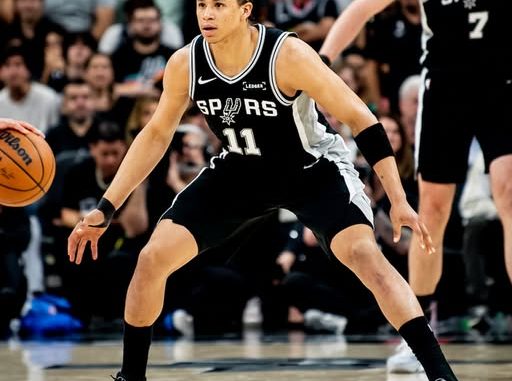
Game 6 delivered a clear and uncompromising message from the San Antonio Spurs: if the whistle was going to be dictated by marginal contact, then they would respond by turning the entire game into a test of physical endurance from the opening tip to the final buzzer. There was no subtlety in their approach, no attempt to rely on finesse or tempo alone. Instead, the Spurs leaned fully into resistance, contact, and disruption, ensuring that every possession for the Oklahoma City Thunder came with an added layer of difficulty that could not be ignored or bypassed.
From the very first minutes, San Antonio established a defensive posture that felt less like a tactical adjustment and more like a collective declaration of intent. Screens were met with immediate pressure. Driving lanes were closed before they fully developed. Catch points were crowded, forcing Oklahoma City into hurried decisions rather than clean reads. Even when the Thunder managed to initiate their offense on schedule, they were met at every turn by bodies willing to absorb contact and contest space without yielding ground.
The tone was set early, and it did not change as the game progressed. Oklahoma City, a team that has built its identity on pace, spacing, and sharp execution in half-court moments, found itself repeatedly pulled out of its comfort zone. What is typically a fluid offensive system became a series of contested actions, with rhythm disrupted before it could fully form. The Spurs were not simply defending; they were dictating the physical language of the game and forcing Oklahoma City to speak it back under pressure.
Across the first quarter, the Thunder’s possessions often began with promise but ended in frustration. Entry passes were deflected or redirected. Ball handlers were forced wider than intended, shrinking passing angles and reducing options. When Oklahoma City attempted to attack downhill, help defenders arrived early and with force, not just contesting shots but altering the entire geometry of the drive. Even when the Thunder managed to get into the paint, finishing became a battle of balance and timing rather than clean elevation.
As the second quarter unfolded, the cumulative effect of that pressure became more visible. Oklahoma City’s shot selection grew increasingly difficult, not because of poor decision-making, but because the Spurs removed easier alternatives. Pull-up jumpers came under duress. Kick-out passes were rushed. Spot-up opportunities, typically a strength for the Thunder, were contested within a fraction of a second. San Antonio’s defensive shell expanded and contracted with precision, but always with the same underlying principle: nothing uncontested, nothing comfortable, nothing free.
What made the Spurs’ approach particularly effective in Game 6 was not just its intensity, but its consistency. There were no extended lapses where Oklahoma City could reset the tone. Even after made baskets or stoppages, San Antonio quickly re-established its physical presence. The Thunder were forced to work through contact on every inbound, every outlet, and every attempt to advance the ball into early offense. That accumulation of pressure mattered as much as any single defensive stop.
By the time the game reached its middle stages, Oklahoma City’s offense had shifted into survival mode. Instead of flowing actions designed to generate mismatches, the Thunder often relied on isolation sequences or late-clock improvisation. While their talent allowed them to remain competitive, the efficiency of their system was clearly disrupted. Passes that normally arrived on time were slightly delayed. Movements that typically created separation were met with immediate recovery pressure. The margin for error, already thin in a series of this magnitude, became even narrower under San Antonio’s defensive insistence.
The Spurs, meanwhile, embraced the physicality not just defensively but as a broader identity for the game. Their rebounding effort reflected that same mindset, with multiple players committing to gang rebounding principles and refusing to concede second-chance opportunities without a fight. Every loose ball was treated as a decisive moment, every deflection as a potential turning point. That collective urgency reinforced the tone they had established from the opening tip.
Offensively, San Antonio did not always operate with perfect rhythm, but their defensive dominance allowed them to control the emotional pace of the game. Even when possessions broke down or shots failed to fall, they were able to reset quickly because their defensive foundation remained intact. The game, in many ways, became less about scoring bursts and more about who could endure longer stretches of resistance without losing composure.
Oklahoma City’s response, to their credit, was not passive. The Thunder attempted to match the physical standard, driving harder into contact and increasing their defensive pressure on the perimeter. There were moments where they successfully disrupted San Antonio’s sets and forced turnovers that led to transition opportunities. However, those moments were intermittent rather than sustained, and they were often followed by stretches where the Spurs regained control of the game’s physical rhythm.
As the fourth quarter approached, the tension of the contest became increasingly pronounced. Every possession carried amplified significance, not just because of the score but because of the manner in which the game had been shaped. This was no longer simply a tactical battle; it had become a test of composure under sustained physical strain. Players on both sides were forced to process fatigue, contact, and pressure simultaneously, while still executing at a high level.
The Spurs continued to lean into their identity, refusing to soften their approach even as fatigue accumulated. Their defensive rotations remained sharp, their help principles intact, and their willingness to contest shots unwavering. Oklahoma City, facing a wall of resistance on nearly every trip down the floor, began to rely more heavily on individual creation. While that produced occasional breakthroughs, it also reduced the consistency of their offensive flow.
In tight playoff environments, such shifts often define outcomes. Systems give way to improvisation. Structure gives way to will. And in Game 6, San Antonio appeared determined to ensure that if the game was going to become a series of isolated, physical moments, they would be prepared for every one of them.
The final minutes of the contest reflected everything that had been established over the previous three quarters. Possessions were longer, more deliberate, and far more physically taxing. Each defensive stop required multiple efforts. Each basket was earned through contact and persistence rather than clean execution. The Spurs’ approach did not waver, and that consistency ultimately shaped the narrative of the game more than any single scoring run or highlight sequence.
By the final buzzer, the message from San Antonio was unmistakable: they were willing to turn the series into a war of attrition if necessary. Not through recklessness, but through discipline applied at maximum intensity. Their defense was not reactive; it was defining the terms of engagement.
Now, with Game 7 looming, the implications of that approach take center stage. In series-deciding games, especially between teams as evenly matched as these two, the emotional and physical tone established in the previous contest often carries forward. What happened in Game 6 was not just a standalone performance; it was a preview of the conditions that both teams are likely to face when everything is on the line.
Oklahoma City enters the decisive matchup fully aware of the challenge that awaits. Adjustments will be required, not just in scheme but in mentality. The Thunder will need to find ways to generate cleaner looks earlier in possessions, before San Antonio’s defensive shell fully sets. Transition opportunities, which can neutralize half-court pressure, may become even more critical. And above all, ball security will be paramount, as turnovers in a game of this magnitude can quickly shift momentum beyond recovery.
At the same time, the Thunder’s resilience throughout the season suggests they are far from unprepared for this moment. This is a group that has consistently responded to adversity with composure and competitiveness. The expectation internally will not be to avoid physicality, but to absorb it and respond with equal force. That includes attacking mismatches more aggressively, increasing off-ball movement to shake defensive pressure, and maintaining composure when possessions break down.
For San Antonio, the challenge is equally demanding. Maintaining the level of defensive intensity displayed in Game 6 over another full contest will require not only physical endurance but mental discipline. The Spurs will need to avoid overextending, stay connected in rotations, and continue to contest without fouling unnecessarily. In games where physicality defines the tone, foul trouble can quickly undermine even the most dominant defensive efforts.
What makes Game 7 particularly compelling is that neither team appears willing to concede the physical identity of the series. Both squads have demonstrated that they are capable of responding to pressure with force rather than retreat. That creates a scenario in which execution under duress becomes the defining factor. Talent alone will not be enough. Strategy alone will not be enough. Even effort alone will not be enough.
Instead, the outcome will hinge on which team can maintain clarity when fatigue sets in, which group can continue to execute fundamentals when every action is contested, and which side can impose structure on chaos when the game inevitably tightens. These are the margins that define elimination games, where the difference between advancing and going home is often measured in single possessions.
As anticipation builds, the basketball world turns its attention to a Game 7 that promises not just competition, but collision. The Spurs have already signaled their intent to make every possession a physical negotiation. The Thunder will now have to decide whether they can meet that challenge without losing the offensive identity that carried them this far. When the stakes rise and the pressure peaks, only one team will be able to withstand the full weight of the moment and earn the right to move one step closer to the NBA’s biggest stage.
Be the first to comment