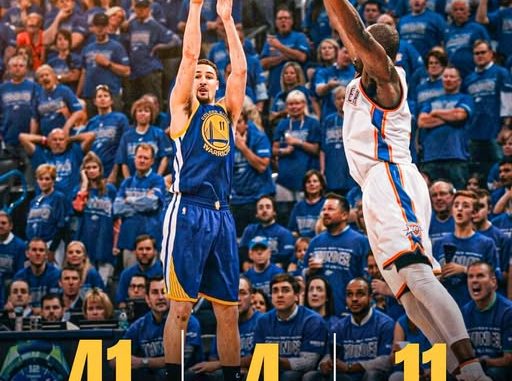
On nights when the margins of an NBA season feel razor-thin, when elimination hangs in the air like a tightening noose and momentum threatens to slip away for good, greatness has a way of arriving uninvited, undeniable, and unforgettable. That is exactly what unfolded in Game 6 of the Western Conference showdown between the Golden State Warriors and the Oklahoma City Thunder, where Klay Thompson detonated one of the most explosive postseason shooting performances of his career—41 points, 11 made threes, and a night that forced a Game 7 while reigniting the Warriors’ championship ambitions in dramatic fashion.
The building was tense long before tipoff, a playoff atmosphere thick with expectation and fear in equal measure. Golden State entered knowing that another loss would end their season, their dynasty-era core once again staring at the possibility of an early exit. Oklahoma City, younger but battle-tested beyond its years, carried the confidence of a team that believed it was already at the edge of something bigger. But by the end of 48 unforgettable minutes, the story belonged almost entirely to Thompson.
From the opening possession, there was a different energy to his movement—quicker into his dribble, more decisive on his footwork, and locked into that familiar rhythm that has terrorized defenses for more than a decade. His first three didn’t even need time to settle the nerves; it was immediate validation that this was going to be one of those nights. And once Thompson feels it, history suggests there is very little any defense can do to stop it.
The Thunder attempted to adjust early, switching coverages, crowding his airspace, and sending late help whenever he turned the corner. But Thompson’s mastery lies not only in shooting but in patience—his ability to wait half a beat longer than defenders expect, to drift into the smallest window of space, and to punish even the slightest hesitation. By the end of the first quarter, he had already begun to bend the game toward Golden State’s will, stringing together a series of catch-and-shoot threes that shifted the tone of the night.
Oklahoma City, however, refused to blink. Their young core responded with pace and aggression, pushing the ball in transition and attacking the Warriors’ defense before it could set. The Thunder’s offense found rhythm through penetration and kick-outs, testing Golden State’s rotations and forcing early defensive stress. For stretches, it looked like the kind of Game 6 where youth and speed might finally overwhelm experience.
But then Thompson went to another level.
The second quarter became a personal shooting clinic. Every action seemed designed to free him, and every possession seemed to end the same way: a quick trigger release from beyond the arc, followed by the familiar arc of a shot that looked pure the moment it left his hand. What made it more devastating was the variety. He hit pull-ups in transition, corner threes off baseline screens, and deep wing shots that forced Oklahoma City defenders to turn in frustration before the ball even dropped through the net.
By halftime, the Warriors were ahead, but the game still felt alive—volatile, unstable, capable of swinging in either direction. That uncertainty only heightened the stakes of what was coming.
The third quarter is where playoff legends are often made, and Thompson understood the assignment without needing instruction. Oklahoma City tried to switch more aggressively, tried to take the ball out of his hands, tried to physically disrupt his rhythm. Instead, they only delayed the inevitable. He would relocate, sprinting through screens, reappearing in pockets of space that seemed to open up just for him. And when the ball found him, the release was instantaneous.
It was during this stretch that the arena began to feel the inevitability of it all. Every make drew louder reactions not just from Warriors fans but from neutral observers witnessing something that felt both familiar and fresh at the same time. Familiar because Thompson has authored nights like this before. Fresh because every time it happens in a playoff elimination context, it still feels surreal.
Behind him, the veteran leadership of the Warriors steadied the team’s structure. Draymond Green anchored defensive possessions, calling out coverages and helping neutralize Oklahoma City’s interior drives. Stephen Curry, though not the headline scorer this night, orchestrated spacing and drew defensive attention that subtly created more room for Thompson’s explosion. It was a reminder that even when one star carries the scoring load, Golden State’s ecosystem remains built to amplify greatness when it appears.
Still, the story was unmistakably Thompson’s.
The fourth quarter arrived with the Warriors clinging to control but far from comfort. Oklahoma City made one final push, as young teams often do in these moments, cutting into the deficit with relentless drives and timely defensive stops. The energy inside the arena shifted again, tension returning with every missed Golden State possession. But then came the moment that defined the night.
With the shot clock ticking and Oklahoma City threatening to fully erase the margin, Thompson curled off a screen, caught the pass in stride, and rose without hesitation. The ball snapped through the net, and the arena erupted not just in celebration but in recognition. That shot didn’t just extend the lead—it broke something in the game’s competitive balance.
From there, the Warriors never relinquished control.
As the final minutes unfolded, Thompson added his 11th three-pointer, sealing a performance that felt both historic and symbolic. It wasn’t simply about scoring; it was about timing, stakes, and legacy. This was the kind of game that redefines narratives. A series that had tilted back and forth now swung firmly toward survival for Golden State, with everything hinging on one final game.
When the buzzer finally sounded, the Warriors had done enough to extend their season to Game 7. But the headline was already written long before the final horn: Klay Thompson had delivered a masterclass under pressure that reminded the basketball world exactly who he is when the stakes are highest.
In the locker room afterward, the mood was controlled but charged. No one celebrated prematurely. There was an understanding that survival is only meaningful if it leads to completion. The job was not finished, but it had been saved—at least for one more night—by a shooting performance that will live in postseason memory for years to come.
For Oklahoma City, the loss stung not just because of the result, but because of how it unfolded. They had done enough in stretches to compete, even to lead moments of momentum. But against a performance like Thompson’s, there is only so much defense can do. Great shooting nights in the NBA are not always preventable—they are simply survivable for as long as possible before inevitability takes over.
For Golden State, the implications were enormous. A season that looked on the brink now suddenly had life again. A Game 7 loomed, and with it, the possibility of a Finals run that just hours earlier felt like a fading dream. The Warriors have built their identity on resilience, on championship DNA forged through years of playoff battles, and once again they found themselves leaning on that foundation.
And at the center of it all stands Thompson, whose reputation as one of the most lethal shooters in basketball history only grows with nights like this. Injuries, slumps, and questions about longevity have all followed him in recent years, but performances like this cut through all of that noise. When he gets hot, there are few players in the league—past or present—who can alter a playoff series so completely in such a short span.
As attention now turns to Game 7, the Warriors carry both momentum and urgency. They are one win away from a defining chapter in yet another Finals pursuit, and they will once again lean on their championship core to navigate the pressure.
But long after this series concludes, regardless of how far Golden State goes, Game 6 will be remembered for one thing above all else: a Splash Brother masterpiece that reminded the NBA that Klay Thompson’s silence can be temporary, but his explosions are eternal.
Be the first to comment