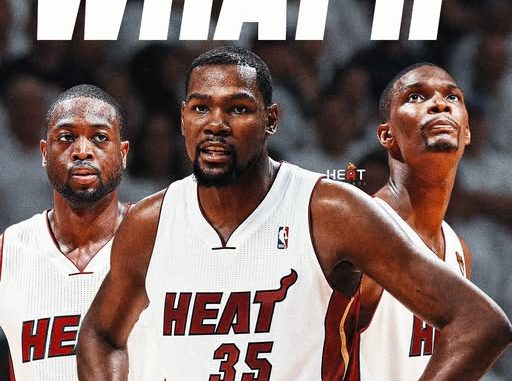
In the summer of 2016, the NBA stood at one of the most pivotal crossroads in league history. The basketball world was still recovering from the emotional chaos of the Finals, where LeBron James delivered Cleveland its first championship after overcoming a 3-1 deficit against the 73-win Golden State Warriors. Yet while the confetti was still falling in Ohio, another storyline quietly hovered over the league like a storm cloud waiting to break. The future of Kevin Durant was about to reshape professional basketball.
History remembers Durant choosing Golden State, creating arguably the most talented superteam the NBA had ever seen. The move instantly altered championship balance, ignited debates about competitiveness, and produced two titles in three seasons. But there remains one fascinating alternate reality NBA fans still revisit a decade later: what if Durant had chosen the Miami Heat instead?
It was not fantasy. It was real. Miami had a meeting. Miami had the culture. Miami had the cap flexibility. And perhaps most importantly, Miami had Pat Riley, the architect of one of basketball’s most iconic dynasties. For a brief moment in 2016, the possibility of Durant in South Beach felt dangerously plausible.
The timing could not have been more dramatic. The Heat were emerging from the emotional aftermath of the LeBron James era. Four straight Finals appearances and two championships had transformed the franchise into a destination organization, but LeBron’s return to Cleveland in 2014 left Miami searching for its next identity. By 2016, however, there was still enough star power in place to make the franchise incredibly attractive.
Dwyane Wade remained the face of the organization, even as age and injuries began to slow him physically. Chris Bosh was still one of the league’s most versatile big men, though his health situation had become increasingly uncertain due to blood clot complications. Miami had also developed a rising star in Hassan Whiteside and possessed one of the NBA’s most respected coaches in Erik Spoelstra.
Then there was the allure of Heat Culture itself.
Around the league, Miami’s reputation had evolved beyond beaches and nightlife. Players spoke about conditioning standards, organizational discipline, player development, and the relentless expectations Riley demanded from every roster. The Heat were viewed as serious, stable, and championship-obsessed. For a superstar chasing legacy, Miami presented an environment that blended glamour with accountability.
Durant’s free agency tour reflected how coveted he had become. Every major contender wanted a meeting. The Warriors sold basketball perfection. The Oklahoma City Thunder tried to convince him to stay loyal to the franchise he had carried for nearly a decade. The San Antonio Spurs pitched continuity and championship pedigree following Tim Duncan’s retirement. Boston and the Clippers circled aggressively.
But Miami’s presentation reportedly stood apart because it wasn’t only about basketball. Riley understood stars. He understood ambition. He understood how elite athletes viewed immortality.
For years, Riley had sold superstars on the idea that greatness was not simply measured in championships, but in eras created. That philosophy worked on LeBron and Bosh in 2010. Six years later, he attempted to sell Durant on becoming the next transformational centerpiece of the Heat dynasty.
Imagine the vision Miami presented behind closed doors. Durant alongside Wade in the twilight of his career. Bosh spacing the floor as one of the most adaptable bigs in basketball. Spoelstra orchestrating a modern offense around Durant’s impossible scoring versatility. Miami’s pace-and-space philosophy would have evolved almost overnight into something terrifying.
Basketball-wise, the fit was obvious.
Durant had already established himself as one of the purest scorers the game had ever seen. At nearly seven feet tall with guard skills, he could shoot over anyone, attack off the dribble, and defend multiple positions. In Miami’s system, he likely would have enjoyed enormous freedom while avoiding the burden of carrying every offensive possession the way he did in Oklahoma City.
Spoelstra’s creativity also made the scenario fascinating. During the Heat’s Big Three years, Miami leaned heavily into positionless basketball before much of the NBA fully embraced it. Small-ball lineups with Bosh at center had already helped revolutionize the league. Add Durant into those concepts, and Miami could have unleashed devastating combinations of speed, spacing, and switchable defense.
The possibilities become even more intriguing when considering how the rest of the NBA might have changed.
If Durant signs with Miami, Golden State never becomes the overwhelming juggernaut that defined the late 2010s. Instead of four straight Finals between Cleveland and Golden State, the Eastern Conference suddenly transforms into a bloodbath.
A Durant-led Heat team against LeBron’s Cavaliers would have instantly become the NBA’s defining rivalry. The emotional stakes alone would have been staggering. LeBron had left Miami to reclaim Cleveland’s glory. Wade was still Miami royalty. Riley remained one of the most competitive executives in sports. Durant entering that equation would have created a collision between former allies and evolving superstars unlike anything the league had seen.
Every regular-season meeting would have felt like a Finals preview.
Would LeBron have still dominated the East so comfortably? Perhaps not. Miami already pushed deeper playoff teams despite injuries and roster instability. Adding Durant may have shifted the balance of power immediately. Instead of Cleveland cruising through a weakened conference, LeBron may have faced a legitimate superteam directly in his path every spring.
For Durant himself, the narrative surrounding his career may have unfolded very differently.
His decision to join Golden State became one of the most controversial superstar moves in sports history. Critics argued he joined an already historically dominant team that had just eliminated him in the Western Conference Finals. Though Durant won Finals MVPs and championships, debates about validation and legacy followed him constantly.
A move to Miami likely would have avoided much of that backlash.
The Heat were respected, but they were not coming off a 73-win season. Wade was aging. Bosh’s future was uncertain. Miami was viewed as dangerous, but not unbeatable. Durant joining the Heat would have resembled building something new rather than attaching himself to an already completed dynasty.
In that alternate reality, Durant may have been celebrated as the singular force reviving Miami’s championship ambitions rather than criticized for tipping competitive balance.
The basketball fit with Wade also deserves deeper reflection. While Wade was no longer in his athletic prime by 2016, his leadership and ability to attack the rim still commanded defensive attention. Durant’s perimeter shooting and off-ball movement would have complemented Wade’s slashing beautifully. Miami could have staggered their minutes to preserve Wade physically while maximizing Durant’s offensive dominance.
And then there is the great “what if” surrounding Bosh.
One of the NBA’s cruelest realities is that Bosh’s career was effectively cut short due to health complications. Had he remained healthy alongside Durant, Miami’s frontcourt versatility could have become historically unique. Bosh’s willingness to sacrifice touches and embrace modern spacing concepts made him one of the league’s ideal superstar teammates. His ability to defend smaller players and stretch defenses would have amplified Durant’s offensive freedom dramatically.
Even without Bosh at full strength, Riley likely would have aggressively retooled the roster around Durant over the following years. Miami’s front office consistently uncovered valuable role players and maximized overlooked talent. The organization’s developmental pipeline later produced names like Bam Adebayo, Tyler Herro, and Duncan Robinson. One can only imagine what veteran ring-chasers might have accepted minimum contracts to play alongside Durant in South Beach.
The ripple effects across the NBA would have been massive.
Golden State without Durant may still have remained elite behind Stephen Curry, Klay Thompson, and Draymond Green. But the league would have felt far more open. Houston’s rise under James Harden may have produced different playoff outcomes. The Spurs might have remained stronger contenders longer. The Celtics’ eventual emergence in the East could have been delayed by a dominant Miami presence.
Even Wade’s future might have changed.
In reality, contract tensions between Wade and Miami resulted in the franchise icon leaving for the Chicago Bulls in 2016. But if Durant commits to Miami, there is little doubt Riley prioritizes keeping Wade in South Beach at all costs. The Heat would have been all-in on immediate title contention, and Wade likely finishes his prime years alongside Durant in pursuit of another championship.
That possibility alone changes the emotional history of the franchise.
Instead of Wade briefly leaving Miami, perhaps he spends his entire career with the organization uninterrupted. Perhaps Durant becomes the bridge between eras, connecting Wade’s championship culture to the next generation of Heat basketball.
Of course, alternate histories often ignore the complexities that make reality unpredictable. Durant to Miami would not have guaranteed championships. Health issues, chemistry challenges, and the relentless pressure of expectations still would have existed. LeBron’s Cavaliers remained formidable. Golden State without Durant still possessed elite talent and championship experience.
But the possibility remains captivating precisely because it feels believable.
Durant nearly joined Miami at a moment when the franchise still carried championship credibility and enormous star appeal. Riley had already proven he could lure generational talent. Spoelstra had established himself among the league’s elite coaches. South Beach remained one of basketball’s premier destinations.
And Durant, despite ultimately choosing Golden State, reportedly admired Miami’s organizational structure deeply.
Years later, NBA fans continue revisiting these hypothetical scenarios because they reveal how fragile league history can be. Dynasties, legacies, championships, and narratives often hinge on a single decision made in a conference room during free agency.
One signature can alter everything.
The Heat understood that better than almost anyone. Their 2010 formation of the Big Three permanently changed how stars approached collaboration and empowerment. Six years later, they came remarkably close to reshaping the league once again.
Instead, Durant chose Golden State, and the NBA entered one of its most dominant dynastic stretches ever. The Warriors captured championships in 2017 and 2018, Durant collected Finals MVP trophies, and debates surrounding competitive balance consumed sports television for years.
Meanwhile, Miami transitioned into a different phase. Wade eventually returned home before retiring. Bosh’s career sadly ended prematurely. Spoelstra rebuilt patiently around younger stars and organizational depth, eventually leading the Heat back to multiple Finals appearances in the 2020s through grit, culture, and development rather than overwhelming superstar collections.
Still, the ghost of 2016 lingers.
What if Durant wore black and red instead of blue and gold? What if South Beach became the center of basketball’s next empire? What if LeBron’s path through the East suddenly ran through Wade and Durant every postseason?
NBA history may never offer definitive answers, but the fascination remains eternal because the scenario was never impossible. It was close enough to feel real.
And in a league built on legacy, few alternate realities remain more tantalizing than the superteam Miami nearly created.
Be the first to comment