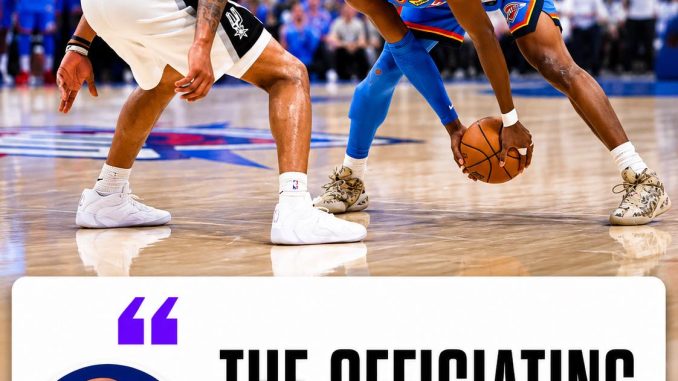
The pressure surrounding NBA officiating has reached a boiling point during this year’s postseason, and now Commissioner Adam Silver is stepping directly into the storm. As criticism from players, coaches, analysts, and fans continues to intensify across the league, Silver publicly defended the physical style of playoff basketball and the officials tasked with managing it, delivering a message that many around the NBA interpreted as both a warning and a reassurance: the league is not interested in over-policing postseason intensity.
“Let them play,” Silver reportedly emphasized while addressing concerns over playoff officiating, a phrase that has increasingly become the unofficial slogan of the NBA postseason. But while some around the league appreciate the return to a tougher brand of basketball, others believe the balance has tipped too far, creating inconsistency, confusion, and unnecessary danger during the most important games of the season.
The debate has only intensified as the conference finals have produced several controversial moments that reignited long-standing concerns about officiating standards. From hard fouls and no-calls to technical foul disputes and questionable replay reviews, nearly every playoff series has featured sequences that dominated postgame discussion as much as the basketball itself.
The Western Conference Finals between the San Antonio Spurs and the Oklahoma City Thunder have become one of the clearest examples of the issue. The series has featured relentless physicality, emotional confrontations, and repeated complaints from both sides regarding what constitutes acceptable playoff contact.
Game 5, in particular, became a flashpoint after several players openly questioned the whistle following Victor Wembanyama and Shai Gilgeous-Alexander repeatedly absorbing heavy contact in the paint with minimal foul calls. Fans flooded social media with slow-motion clips, comparing regular-season fouls to postseason no-calls and accusing officials of applying entirely different standards once the playoffs begin.
Silver, however, defended that distinction. According to league insiders, the commissioner believes playoff basketball should naturally feature a higher threshold for contact, arguing that excessive whistles can disrupt rhythm, diminish intensity, and ultimately hurt the viewing experience. The NBA’s leadership reportedly sees physical postseason basketball as part of the sport’s identity rather than a problem that must be eliminated.
That philosophy has not satisfied everyone.
Several current and former players have argued that the inconsistency—not the physicality itself—is the real issue. Many around the league believe players can adapt to almost any officiating style if the rules are applied evenly. The frustration grows when similar plays receive drastically different interpretations from game to game or even quarter to quarter.
Former players working as television analysts have been especially vocal. Multiple ESPN and TNT commentators have criticized the league for what they view as unclear standards regarding hand-checking, verticality, and continuation calls. The replay system has also come under fire, with critics arguing that lengthy reviews often fail to deliver greater clarity despite slowing down momentum and increasing fan frustration.
The controversy arrives during one of the NBA’s most competitive postseasons in recent memory. The emergence of younger stars like Wembanyama, Gilgeous-Alexander, Jalen Brunson, and Tyrese Haliburton has injected fresh energy into the league, while veteran superstars continue to command enormous attention. Yet instead of focusing solely on the performances themselves, conversations after many games have revolved around officiating controversies.
That tension became especially visible during the Eastern Conference Finals, where the New York Knicks completed a dominant sweep of the Cleveland Cavaliers amid repeated complaints from Cleveland players about inconsistent whistle treatment near the rim. Several Cavaliers veterans privately expressed frustration over what they viewed as playoff “guesswork” from officials, particularly regarding physical drives and transition contact.
Meanwhile, Knicks players largely welcomed the tougher environment, arguing that postseason basketball should reward physical resilience. That divide reflects a larger philosophical split across the league. Some organizations believe the playoffs should resemble old-school basketball, where toughness and physicality are central to success. Others fear the NBA risks encouraging overly aggressive play that increases injury risk and reduces offensive creativity.
Silver’s comments appear designed to reinforce the league’s commitment to postseason intensity while also defending referees who have become constant targets of criticism. League officials privately acknowledge that officiating NBA games has become significantly more difficult in the social media era, where every whistle is instantly dissected from multiple camera angles and amplified across platforms within seconds.
Referees themselves have faced growing scrutiny throughout the postseason. Veteran officials have reportedly received increased security precautions and online abuse after controversial playoff games, highlighting the enormous pressure attached to modern officiating. The NBA Referees Association has repeatedly defended its members, arguing that many controversial clips circulated online lack proper context or ignore the speed at which decisions must be made in real time.
Silver echoed some of those concerns, emphasizing that officiating perfection is impossible in a sport played at extraordinary speed by elite athletes. The commissioner reportedly pointed to internal evaluation systems that grade referees after every game, insisting the league remains confident in the overall quality of its officiating crews despite public criticism.
Still, the optics remain challenging for the NBA.
The league has spent years emphasizing freedom of movement, offensive flow, and player protection, especially after criticism during the slower, more physical eras of the late 1990s and early 2000s. But playoff basketball consistently drifts back toward heavier contact, creating what some players describe as a “two-rulebook system” between the regular season and postseason.
That contrast has become even more visible with younger stars who grew up in a more perimeter-oriented era. Players accustomed to foul calls during the regular season sometimes appear shocked by playoff whistles—or lack thereof. Coaches, meanwhile, have strategically tested officiating boundaries, encouraging defenders to increase physical pressure until referees demonstrate where the line will actually be drawn.
The Spurs-Thunder series has perfectly illustrated that chess match. Wembanyama’s length and interior dominance have forced Oklahoma City defenders into constant physical battles around the basket, while Gilgeous-Alexander’s relentless attacking style has created endless collision plays that place enormous pressure on officials. Every possession feels magnified, and every whistle—or non-whistle—carries potential series-changing consequences.
As a result, Silver’s “let them play” stance has become both popular and polarizing.
Many longtime fans applauded the commissioner’s comments, arguing that playoff basketball should feel tougher and more emotional than the regular season. Supporters of the current approach believe too many fouls can make games feel mechanical, reducing dramatic tension and removing the physical edge that defines championship competition.
Others strongly disagree. Critics argue that “letting them play” often becomes selective enforcement rather than consistent officiating. They point to situations where star players absorb repeated contact without calls, only for softer fouls to suddenly be whistled moments later. That unpredictability, opponents say, damages competitive fairness more than strict officiating ever could.
There is also concern about player safety.
This postseason has already featured several injury scares tied to heavy contact, including collisions during transition plays and hard fouls under the basket. Coaches around the league have privately questioned whether the NBA risks encouraging escalation by allowing increasingly physical play to continue unchecked.
The debate recalls similar controversies from previous postseason eras involving stars like LeBron James, Stephen Curry, and James Harden, all of whom experienced dramatic differences between regular-season and playoff officiating during different stages of their careers. Those discussions never fully disappeared, but the rise of social media and instant replay culture has amplified them to unprecedented levels.
Every fanbase now possesses an endless archive of screenshots, clips, freeze-frames, and slow-motion breakdowns ready to support claims of bias or incompetence. Television broadcasts regularly devote extended segments to officiating analysis, while former referees appear on major sports networks to explain controversial rulings in real time.
Yet despite the constant criticism, many coaches remain careful publicly when discussing officials. The NBA’s fining system for referee criticism still carries significant financial penalties, leading many teams to voice frustrations privately instead of openly challenging the league office.
Silver’s decision to address the issue publicly may reflect growing concern within the league about the narrative surrounding the playoffs. The NBA wants conversations centered on stars, rivalries, and championship drama—not exclusively on officiating controversies.
So far, that has proven difficult.
The emotional nature of postseason basketball guarantees scrutiny, especially when games are close and stakes are enormous. A single whistle can shift momentum, influence legacies, or alter an entire series. In today’s NBA media ecosystem, those moments live forever online.
At the same time, many league observers believe the criticism directed toward referees has become excessive. Former coaches and executives have noted that fans often demand contradictory outcomes: they want physical basketball but also expect consistent foul calls on every collision. Balancing those expectations may be impossible.
Silver appears willing to accept that tension if it preserves what the league views as authentic playoff basketball. The commissioner reportedly believes fans ultimately prefer intense, emotionally charged games over tightly controlled contests dominated by free throws and stoppages.
That philosophy will continue facing scrutiny as the playoffs move closer to the NBA Finals. Every controversial call from this point forward will receive microscopic attention, especially in nationally televised games featuring emerging superstars and championship stakes.
For now, the league office is standing firmly behind its officials.
Whether fans agree with that stance is another question entirely.
As the postseason continues, the NBA finds itself walking a narrow line between toughness and chaos, between entertainment and fairness, and between protecting players while preserving the raw emotional edge that makes playoff basketball unforgettable. Silver’s message was unmistakable: the league does not want postseason games decided by excessive whistles.
But in a playoff environment already overflowing with pressure, intensity, and controversy, the louder question may be whether the NBA can maintain that philosophy without losing the trust of players, coaches, and fans who increasingly believe the line between “letting them play” and losing control is becoming dangerously thin.
Be the first to comment