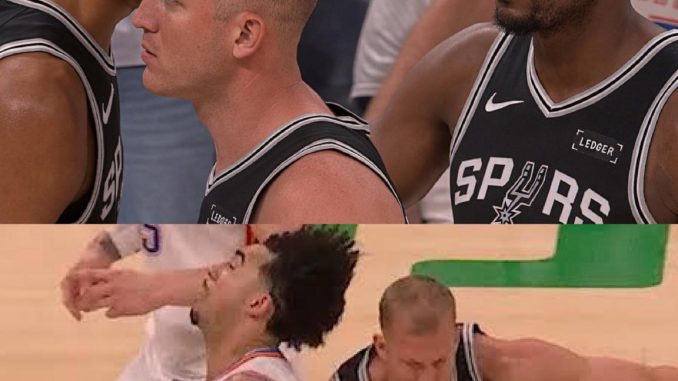
Whispered Instructions, Immediate Impact: Wembanyama’s Sideline Exchange with Plumlee Precedes Hard Foul on McCain
What began as a routine mid-game sequence quickly turned into one of the most talked-about moments of the night, as a brief but intense sideline exchange between Victor Wembanyama and Mason Plumlee appeared to precede a controversial hard foul on rookie guard Jared McCain, shifting the tone of an otherwise tightly contested matchup and igniting debate across the arena and beyond.
The play unfolded midway through the third quarter of a game that had, until that point, been defined by pace, spacing, and controlled physicality. Both teams were locked in a narrow scoring battle, with neither side able to create separation larger than a single possession. But everything changed in a matter of seconds—starting not with a shot, not with a turnover, but with a quiet conversation along the sideline that few noticed in real time and even fewer understood until the aftermath replay began circulating.
Wembanyama, stationed near the bench area during a brief stoppage, leaned toward Plumlee after a defensive rotation. Cameras captured the exchange only in fragments: a nod from Plumlee, a pointed gesture from Wembanyama toward the opposite end of the floor, and a few indistinct words that lip-readers later suggested were related to positioning and transition awareness. There was nothing overtly dramatic about the moment, nothing that would normally draw attention in a game filled with constant communication.
Yet within seconds of play resuming, the tone of the possession shifted sharply.
McCain brought the ball up the floor with confidence, pushing tempo and attempting to exploit a half-step advantage at the perimeter. As he crossed into the lane, Plumlee rotated with unusual urgency from the weak side. The contact that followed was immediate, forceful, and unmistakably intentional in its timing. McCain was met in mid-drive by a hard body check that sent him off balance and to the floor, drawing an instant whistle from the officiating crew.
The crowd reaction was instantaneous. Some erupted in approval, interpreting the play as a necessary defensive stand in a high-intensity stretch of basketball. Others responded with audible disapproval, sensing that the level of contact had exceeded what the moment required. McCain remained on the floor for several seconds before being helped up, visibly frustrated but physically able to continue after the stoppage.
Officials quickly convened, reviewing the sequence and assessing the severity of the foul. The ruling ultimately classified the play as a hard common foul, though it was accompanied by a warning to both teams regarding escalating physicality. The decision did little to settle the debate, which had already begun to shift toward what had happened moments before the foul itself.
Replays shown on the arena scoreboard added fuel to the discussion. The sideline exchange between Wembanyama and Plumlee, while brief, became the focal point of attention. Analysts immediately began dissecting body language, timing, and positioning, attempting to determine whether the conversation had any direct influence on the defensive action that followed.
On broadcast coverage, former players and commentators weighed in with differing interpretations. Some insisted the exchange was nothing more than standard in-game communication between teammates and frontcourt players adjusting coverage responsibilities. Others suggested that the timing of the foul—coming almost immediately after the interaction—was too coincidental to ignore, even if no explicit instruction could be confirmed.
Wembanyama, known for his evolving leadership presence despite his relatively young career, did not directly address the interpretation of the exchange during the game. However, teammates and coaching staff later emphasized that his communication on the floor has increasingly become part of the team’s defensive organization, particularly in late-clock and transition scenarios. His defensive awareness has often been cited as one of his most advanced attributes, allowing him to direct traffic even when not directly involved in the play.
Plumlee, for his part, appeared composed after the incident and continued playing without visible escalation. His reputation as a physical interior defender is well established, and the foul itself, while forceful, did not exceed the threshold of typical playoff-style or high-intensity regular-season contact. Still, the context surrounding it ensured that it would be scrutinized far more heavily than similar plays in isolation.
McCain’s reaction added another layer to the moment. The rookie guard, who has quickly earned respect for his poise and shot-making ability, was visibly frustrated as he rose from the floor. He exchanged words with nearby defenders and gestured toward officials, clearly indicating his belief that the contact had been excessive. While he remained in the game, the incident appeared to briefly disrupt his rhythm, as his next two possessions resulted in a missed jumper and a turnover under pressure.
The coaching staffs on both sides responded swiftly. One bench called for greater composure in defensive closeouts, while the other urged continued aggression, framing the foul as a tone-setting moment rather than an infraction. The contrasting messages underscored the broader tension that had been building throughout the game, where physical defense had slowly become more pronounced with each passing quarter.
As the game progressed beyond the incident, it became clear that the moment had altered more than just the scoreboard dynamics. Players on both teams began to operate with heightened awareness, particularly in transition defense and perimeter entry passes. Drives to the basket were met with quicker rotations, and the whistle grew increasingly frequent as officials attempted to maintain control of the physical escalation.
Still, the central narrative continued to orbit back to the sideline exchange. In postgame discussions, analysts replayed the sequence repeatedly, focusing on Wembanyama’s body language. His posture, described by some as directive, was interpreted by others as routine. The ambiguity only deepened the intrigue.
One interpretation suggested that Wembanyama was simply alerting Plumlee to McCain’s positioning tendencies in transition, possibly indicating a pattern the offense had been exploiting earlier in the game. Another theory proposed that the exchange was about switching coverage responsibilities, ensuring that Plumlee would step up earlier on drives to prevent easy lane penetration. Both explanations are consistent with high-level defensive communication and would not inherently imply any intent beyond standard competitive adjustment.
However, basketball narratives are rarely shaped by clarity alone. Timing often plays as large a role as intent in how moments are remembered. The immediate sequence—conversation, possession, foul—created a storyline that naturally invited speculation, even in the absence of definitive evidence linking the two events.
Commentators during halftime emphasized this point, cautioning against overinterpretation while acknowledging the reality that elite-level basketball often operates in these subtle layers of communication. Defensive coordination, particularly among frontcourt players, frequently involves rapid exchanges that the average viewer may not fully capture or contextualize.
Wembanyama’s growing influence on that end of the floor has been one of the defining developments of his young career. Standing as one of the most unique defensive presences in the modern game, his ability to contest shots, alter driving lanes, and orchestrate rotations has drawn comparisons to some of the most impactful defenders in league history. It is within that context that even minor interactions, such as the one with Plumlee, tend to attract outsized attention.
Plumlee’s role in the sequence also cannot be overlooked. As a veteran presence, his defensive instincts are built on repetition and experience, particularly in reading opposing guards’ momentum and timing. The decision to engage McCain physically on that drive, regardless of external interpretation, reflects a split-second judgment that defenders at his position are required to make repeatedly throughout a game.
For McCain, the incident may ultimately serve as part of the learning curve that comes with adjusting to the speed and physicality of professional-level defenses. Rookie guards often encounter moments where angles close faster, rotations arrive sooner, and contact is more decisive than in collegiate play. His response afterward suggested both frustration and adaptation, as he gradually reasserted himself later in the contest with improved ball security and more deliberate shot selection.
As the final minutes of the game unfolded, the earlier controversy gradually receded into the background of an increasingly tactical finish. Both teams tightened execution, with possessions becoming more deliberate and defensive schemes more conservative to avoid further foul trouble. Yet even as the scoreboard took center stage again, conversation among fans and analysts remained fixed on the sequence that had briefly disrupted the game’s flow.
In the postgame locker room availability, players from both sides were careful not to escalate the narrative. Emphasis was placed on competitiveness, communication, and the natural physicality of high-level basketball. No one directly confirmed any instruction or intent behind the sideline exchange, and the lack of concrete clarification ensured that interpretations would continue to diverge.
What remains undeniable, however, is the impact of the moment on perception. In a league where split-second decisions often define outcomes and reputations, the intersection of communication and action can become as significant as the plays themselves. Whether the exchange between Wembanyama and Plumlee directly influenced the foul on McCain may never be conclusively established, but in the rhythm of the game, the sequence has already taken on a life of its own.
And in that space between perception and proof, basketball narratives are often born.
Be the first to comment