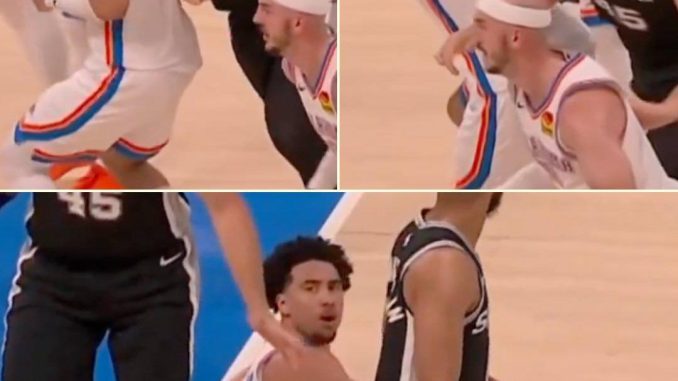
The NBA has officially upgraded Mason Plumlee’s foul on Jared McCain to a Flagrant 1 following a postgame review of Game 5, adding another layer of tension to an already heated Western Conference Finals between the Oklahoma City Thunder and the San Antonio Spurs.
The league’s decision, confirmed after a routine review of late-game physicality, centers on a sequence in the closing minutes of the Thunder’s 127–114 victory over the Spurs, a game that pushed Oklahoma City one win away from the NBA Finals. The foul in question came during a brief but intense stretch in garbage time that quickly escalated from routine contact to controversy, fueling debate about intent, sportsmanship, and the fine line between playoff physicality and unnecessary aggression.
Oklahoma City Thunder now lead the series 3–2, but the aftermath of Game 5 has shifted attention away from the scoreboard and toward the league office, where officials determined that Plumlee’s contact met the threshold of “unnecessary” force under NBA rules, warranting a Flagrant 1 classification rather than a common personal foul.
The play occurred with just over two minutes remaining in a game already decided. McCain, who had been one of the Thunder’s most productive contributors with 20 points in his first career playoff start, was involved in a late offensive sequence when Plumlee delivered heavy contact from behind during a drive. The impact sent McCain stumbling forward and drew immediate reaction from players on both sides. Moments later, another hard foul in the same sequence added to the perception that the game’s closing stretch had crossed into excessive physicality.
Jared McCain, who has emerged as a rising backcourt presence in Oklahoma City’s postseason rotation, appeared shaken but remained in the game to complete the final minutes. His scoring output had already helped stretch the Thunder’s lead beyond reach, but the tone of the contest shifted sharply once the physical exchanges began.
For Plumlee, a veteran known for physical interior play, the moment has now been formally logged in the league’s postseason disciplinary record. The upgrade to a Flagrant 1 does not carry the automatic ejection associated with a Flagrant 2, but it does reflect the NBA’s determination that the contact exceeded what is considered a legitimate basketball play.
Under NBA guidelines, a Flagrant 1 is defined as unnecessary contact committed by a player against an opponent, often involving excessive force that is not part of a normal basketball play. The league’s postgame review process frequently evaluates such incidents in high-stakes playoff environments, where intensity rises and referees must distinguish between hard playoff defense and potentially dangerous physical escalation.
The decision also reinforces the NBA’s ongoing emphasis on player safety, particularly in situations where games are no longer competitively in doubt. League officials have increasingly shown willingness in recent years to upgrade fouls that appear retaliatory, overly aggressive, or unrelated to a genuine play on the ball.
The sequence involving Plumlee was not the only flashpoint in the closing minutes. Earlier and later contact in the same stretch contributed to a broader discussion about whether the Spurs’ late-game defensive approach had become overly physical. According to reports from the game, another hard foul on McCain followed shortly after the initial contact, intensifying scrutiny on the sequence as a whole.
The situation escalated further due to on-court comments that quickly circulated after the game. Plumlee was heard making a remark to McCain during a stoppage that included the phrase, “I got another one for you too,” a comment that has since drawn attention across media coverage and social platforms. While interpretations vary, the NBA’s review focused strictly on the legality and severity of the contact itself rather than verbal exchanges.
Still, the optics of the sequence have been impossible to ignore. The incident unfolded during a postseason series already defined by physicality, shifting momentum, and emotional swings between two teams fighting for a Finals berth. The Thunder’s win in Game 5 put them ahead 3–2, but the aftermath ensured that Game 6 will carry additional emotional weight.
From the Spurs’ perspective, the foul adds to a growing list of concerns about discipline in late-game situations. San Antonio Spurs have leaned heavily on their defensive identity throughout the series, but Game 5 raised questions about whether that edge has occasionally crossed into excess. The league’s decision to upgrade the foul will likely reinforce internal discussions about maintaining composure in moments when games are effectively out of reach.
The controversy also comes at a time when the NBA has been particularly sensitive to postseason physicality. League officials have repeatedly emphasized that while playoff basketball is expected to be more intense, it must remain within the bounds of safety and competitive integrity. In recent seasons, similar incidents have led to upgrades, fines, and in some cases suspensions when contact was deemed excessive or retaliatory.
For Oklahoma City, the focus remains on closing out the series, but the emotional undercurrent from Game 5 is unlikely to disappear quickly. Players and coaches have already been asked about the physical tone of the matchup, and the Thunder are expected to prepare for a similarly intense environment in Game 6, where the Spurs will be fighting to extend the series on their home floor.
McCain’s emergence has been one of the unexpected storylines of the series. Inserted into a starting role, the rookie guard has responded with confidence, spacing, and shot-making that has helped stabilize Oklahoma City’s offense in key stretches. His 20-point performance in Game 5 reinforced his growing importance, even as the postgame narrative shifted toward the foul he absorbed rather than the points he produced.
The Spurs, meanwhile, have leaned on their depth and defensive versatility to stay competitive. Physical defenders rotating through the lineup have attempted to slow Oklahoma City’s perimeter attack, but the challenge has been maintaining that pressure without crossing into excessive contact. The Plumlee incident now stands as the clearest example of how quickly that balance can tilt in a playoff setting.
Around the league, the reaction has been predictable: a mixture of concern over player safety, acknowledgment of playoff intensity, and debate over where the line should be drawn. Some observers view the foul as a natural byproduct of competitive basketball in high-pressure moments, while others argue that the league’s upgrade signals a necessary boundary enforcement.
What cannot be disputed is the timing. With Oklahoma City one win away from the Finals and Game 6 looming, the Spurs now face both a tactical and psychological challenge. They must extend the series without allowing frustration or physical overreaction to dictate the tone of their play. The Thunder, conversely, must remain composed in what is likely to be one of the most hostile environments of their season.
Veteran leadership on both sides will be critical. Players accustomed to deep playoff runs understand how quickly narratives can shift based on a single sequence. A hard foul in Game 5 has now become a talking point that could influence officiating, rotation decisions, and emotional control in the next matchup.
The NBA’s decision to upgrade the foul also serves as a reminder that postseason games are reviewed not only in real time, but also through a broader disciplinary lens. What might be interpreted as a physical playoff moment on the floor can be reassessed once the stakes are separated from the emotion of the game.
As the series moves forward, attention will inevitably return to basketball. Shot-making, adjustments, and execution will determine who advances. But the shadow of Game 5 will linger, especially if the physical tone resurfaces in Game 6.
For now, the official ruling stands: Mason Plumlee’s contact on Jared McCain was excessive enough to warrant a Flagrant 1, a classification that confirms what the moment suggested in real time—that the line between playoff toughness and unnecessary force had been crossed, even if only briefly.
And in a series this tight, even brief moments tend to echo far beyond the final buzzer.
Be the first to comment