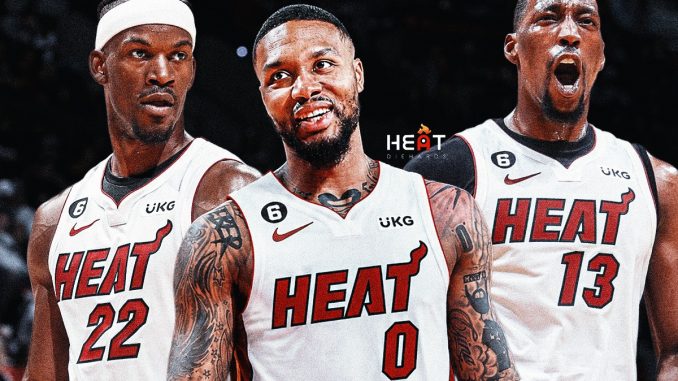
In the summer of 2023, the NBA stood at a familiar crossroads of ambition and uncertainty. Contenders were reshaping rosters, front offices were weighing future flexibility against present opportunity, and one of the league’s most persistent “what if” storylines hovered over the entire landscape: what would it look like if a franchise pushed all its chips in for a true championship superteam?
In this alternate timeline, the Miami Heat answered that question with a decisive swing that altered the balance of the Eastern Conference. Instead of waiting on the margins of trade negotiations and star availability, Miami executed the move it had long been rumored to be circling—landing Damian Lillard and forming a seismic trio alongside Jimmy Butler and Bam Adebayo. The result was not just a roster upgrade, but a philosophical statement: the Heat were no longer content to chase contention. They were redefining it.
From the moment Lillard arrived in Miami, the franchise’s identity shifted from gritty overachievers to outright offensive juggernauts layered on top of an already elite defensive structure. For years, Miami had built its reputation on discipline, conditioning, and tactical execution under Erik Spoelstra’s system. What they lacked at times in half-court scoring dynamism in the postseason, they now solved in one move—adding one of the greatest deep-range shot creators the league has ever seen.
Lillard’s presence immediately transformed spacing in a way Miami had never previously enjoyed. Defenses that once collapsed on Butler’s drives or dared Miami’s role players to beat them now faced a brutal dilemma: stay home on shooters and let Lillard operate in isolation, or help and risk watching him pull up from 30 feet without hesitation. That gravity didn’t just elevate Miami’s offense; it fundamentally distorted opposing game plans.
What made this theoretical pairing so intriguing was not just the star power, but the stylistic contrast that fused into cohesion. Butler, at his core, is a relentless downhill attacker who thrives on physicality, foul pressure, and midrange efficiency. Lillard brings surgical perimeter scoring, long-range pull-up danger, and a late-clock inevitability that few players in NBA history can match. Bam Adebayo sits at the center of it all as the connective tissue—a defensive anchor who can switch across positions while also acting as a high-post facilitator and short-roll decision-maker.
In practice, the Heat’s offense would have evolved into one of the most difficult coverages in basketball. Lillard and Butler alternating high pick-and-roll usage meant defenses could never settle into predictable schemes. Switch too often, and Butler punishes mismatches in the paint. Drop coverage against Lillard, and he buries threes with a defender still recovering from the screen. Trap him, and Adebayo becomes a 4-on-3 problem-solver with passing angles to cutters and corner shooters.
Miami’s half-court offense, which had occasionally stagnated in previous playoff runs, would have gained a new layer of inevitability. Late-game possessions—once a point of tension in close series—become a controlled environment where Lillard’s shot creation reduces chaos. Few players in league history are more comfortable in end-of-clock scenarios, and pairing that with Butler’s clutch mentality created an offensive closing duo that could match any in the league.
Yet the true transformation extended beyond scoring. Butler’s workload, often massive during deep playoff runs, would have been redistributed in a way that preserved his efficiency. Instead of shouldering every tough shot creation responsibility, he could lean into selective aggression, attacking mismatches rather than forcing offense out of necessity. That subtle shift could have extended his postseason stamina, a factor Miami had occasionally struggled with in grueling Eastern Conference battles.
Meanwhile, Adebayo’s role becomes even more valuable in this universe. With defenders focused on perimeter stars, his short-roll game becomes a weapon that punishes hesitation. Whether it’s a floater in the lane, a kick-out to shooters, or a pocket pass to cutting wings, his decision-making turns Miami’s offense into a layered system rather than a star-centric isolation model.
Defensively, the Heat would still be anchored by their established identity. Butler remains one of the league’s premier wing defenders when engaged, Adebayo is among the most versatile big men in basketball, and Spoelstra’s schemes consistently maximize effort and positioning. The concern, naturally, centers on Lillard’s defensive load. Miami would have to strategically shield him, hiding him on weaker offensive threats while relying on team rotations and switching schemes to cover gaps.
But unlike many star-heavy teams that collapse defensively under the weight of offensive additions, Miami’s infrastructure is uniquely suited to absorb such tradeoffs. The Heat culture—built on conditioning, accountability, and defensive discipline—would mitigate many of the concerns that typically accompany high-usage offensive guards.
The Eastern Conference landscape in this alternate 2023-24 season becomes significantly more volatile. Boston, Milwaukee, and Philadelphia would all be forced to recalibrate. Against Boston’s switch-heavy perimeter defense, Miami’s trio presents constant matchup pressure. Butler attacks mismatches relentlessly, Lillard stretches coverage beyond the arc, and Adebayo punishes help defense with interior cuts and facilitation.
Against Milwaukee, the battle becomes a clash of superstar hierarchies. Matching Lillard with elite shot creation against Giannis Antetokounmpo’s transition dominance and interior pressure creates a stylistic chess match that could define the conference. Miami’s ability to slow tempo and execute in half-court sets would be tested against Milwaukee’s physical pace and paint dominance.
In Philadelphia, the Joel Embiid-led structure poses different problems entirely. Miami would be forced to use Adebayo in constant physical engagement while trusting perimeter defenders to contain secondary scoring. Lillard’s pull-up shooting becomes especially important in these matchups, as it forces Embiid into uncomfortable defensive decisions far from the rim.
What separates this hypothetical Heat team from previous iterations is not just talent accumulation, but timing and synergy. Butler is in full command of his prime competitive window, Adebayo is entering his peak two-way years, and Lillard—while no longer at the earliest stage of his career—remains one of the league’s most dangerous offensive engines. The alignment of urgency across all three stars creates a rare cohesion often missing in superteam constructions.
In the playoffs, this trio’s ceiling becomes immediately apparent. Miami’s historical ability to elevate in postseason environments combined with Lillard’s shot-making under pressure creates a team that is comfortable in chaos but also capable of controlling it. Close games no longer feel like coin flips. They become structured opportunities for elite execution.
One of the most intriguing tactical wrinkles would be Miami’s closing lineup decisions. Spoelstra would have the flexibility to rotate between size-heavy and perimeter-heavy groups depending on matchup. In some scenarios, Miami could deploy Lillard, Butler, and Adebayo alongside two sharpshooters, stretching defenses to their breaking point. In others, they could lean into defensive versatility, sacrificing spacing for switchability.
The psychological impact on opponents cannot be overstated. Defending Miami in a seven-game series would require near-perfect execution for 48 minutes. Any lapse in transition defense becomes a Lillard transition pull-up. Any defensive breakdown against Butler becomes free throws or a layup. Any rotation hesitation opens Adebayo as a playmaking hub. The margin for error shrinks dramatically.
Of course, this version of the Heat would not be without vulnerabilities. Ball dominance between Butler and Lillard would require careful calibration. While both are capable off-ball players in spurts, neither thrives as a pure spot-up option for extended stretches. Managing touches and rhythm becomes a constant coaching challenge. Additionally, depth would inevitably be sacrificed in a deal of this magnitude, placing pressure on role players to consistently execute in high-leverage moments.
Still, Miami’s organizational strength has historically been its ability to maximize undervalued talent. Even in a top-heavy construction, the Heat would likely extract meaningful contributions from overlooked rotation pieces, particularly in defensive roles and spot-up shooting assignments.
In the broader historical context, this hypothetical trio would have represented one of the most balanced superteams of the modern era. Unlike purely offensive collectives or defensively skewed contenders, Miami would have combined elite shot creation, versatile defense, and playoff-tested mentality. The blend of personalities—Butler’s edge, Lillard’s calm confidence, and Adebayo’s stabilizing presence—creates a competitive identity that is both volatile and controlled.
Ultimately, the fascination with this “what if” lies in its plausibility. It is not a fantasy built on unrealistic roster gymnastics, but a scenario that, at various points, felt tangibly close to reality. And in that sense, it becomes more than speculation. It becomes a lens through which to evaluate how thin the margins are between a great team and a potential dynasty.
Had Miami secured Lillard in 2023, the Eastern Conference might have looked fundamentally different. Titles, legacies, and narratives would all have shifted under the weight of one transaction. Instead, it remains one of the league’s most compelling alternate histories—a reminder that in the NBA, one move can reshape everything.
Be the first to comment