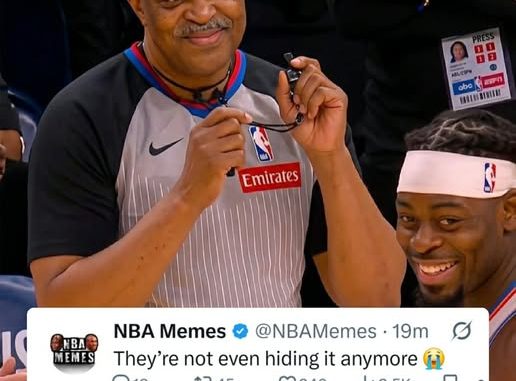
The noise surrounding the NBA playoffs reached another level Tuesday night, and this time it had little to do with a buzzer-beater, a monster dunk, or even a controversial flagrant foul. Instead, social media erupted over a sequence during Game 5 of the Western Conference Finals between the Oklahoma City Thunder and the San Antonio Spurs that left fans across the basketball world screaming the same thing: “They’re not even hiding it anymore.”
The internet can turn any NBA moment into a wildfire within seconds, but this latest reaction carried a different kind of energy. It wasn’t simply frustration. It wasn’t ordinary playoff complaining. It was the type of collective outrage that floods timelines when fans believe they have witnessed something that confirms their deepest suspicions about officiating, star treatment, and league favoritism.
And as clips circulated at lightning speed across X, Instagram, TikTok, and Reddit, the memes quickly followed. Crying-laughing emojis filled comment sections. Skull emojis appeared by the thousands. Slow-motion replays were broken down frame-by-frame like Zapruder film footage. Former players chimed in. Podcast personalities posted instant reactions. Even neutral fans admitted the sequence looked suspicious enough to spark another all-night debate about whether NBA officiating has become too influential during marquee playoff moments.
The controversy centered around yet another aggressive performance from Shai Gilgeous-Alexander, whose relentless attacks toward the basket have become both his greatest weapon and the source of endless frustration for opposing fanbases throughout these playoffs. The Thunder superstar once again lived at the free-throw line, finishing the night with 17 attempts as Oklahoma City defeated San Antonio 127-114 to seize a 3-2 series lead.
But it wasn’t simply the number of free throws that triggered the backlash. It was how they came.
Midway through the second half, one possession in particular sent social media into complete meltdown mode. Gilgeous-Alexander drove into the lane, absorbed marginal contact, and immediately earned another whistle. Spurs players threw their hands in the air in disbelief. The crowd erupted with boos. Replays only intensified the reaction online, where countless users argued the contact appeared minimal at best.
Within minutes, posts accusing the officials of favoring Oklahoma City dominated trending topics.
“They’re not even hiding it anymore,” one viral post read alongside a replay clip that accumulated millions of views in just hours.
Another fan wrote, “You can’t breathe near SGA without a whistle.”
Others compared the sequence to some of the most infamous foul-drawing debates in modern NBA history, invoking names like James Harden, Joel Embiid, and even peak-era Dwyane Wade during his relentless slashing years with the Miami Heat.
The discussion instantly split basketball fans into two very familiar camps.
One side argued the outrage was exaggerated and rooted more in frustration over Gilgeous-Alexander’s dominance than actual officiating bias. Those supporters pointed out that the Thunder guard relentlessly pressures defenses, attacks downhill, changes pace better than almost any player in basketball, and constantly forces defenders into awkward positions.
“He leads the league in drives for a reason,” one analyst posted. “If defenders can’t stay in front of him, fouls happen.”
The opposing side, however, believed the whistles crossed the line from understandable to absurd. To them, the issue wasn’t one or two borderline calls. It was the accumulation of repeated soft fouls that seemed to arrive whenever momentum threatened to swing toward San Antonio.
That frustration only intensified because of the stakes attached to the game. The series itself has already become one of the most emotional and physical matchups of the postseason, with Victor Wembanyama and Gilgeous-Alexander emerging as the defining faces of the Western Conference’s new generation.
Every possession now feels magnified. Every whistle feels personal.
And in the social media era, every replay becomes evidence.
What made the reaction especially explosive was the perception that the NBA may prefer certain storylines advancing deeper into the postseason. Conspiracy theories are hardly new in basketball discourse, but playoff officiating always amplifies them. Fans dissect television ratings, marketability, superstar narratives, and league promotion strategies as if they are solving a detective case.
This latest incident became gasoline on that fire.
For some Spurs supporters, the idea that Oklahoma City and Gilgeous-Alexander are being positioned as the NBA’s next great mainstream attraction feels impossible to ignore. The Thunder are young, electric, fast-paced, and led by one of the league’s smoothest offensive players. Gilgeous-Alexander’s calm demeanor and midrange mastery have made him one of basketball’s fastest-rising superstars.
Meanwhile, Wembanyama’s meteoric rise has already transformed San Antonio into must-watch television. The French phenom has delivered staggering playoff moments throughout this series, including dominant scoring explosions, impossible defensive recoveries, and highlight blocks that seem to bend reality.
The matchup itself almost feels scripted for a changing-of-the-guard era in the NBA.
That is precisely why officiating debates become so emotionally charged. Fans already view the series through the lens of legacy, stardom, and league politics. Every whistle becomes symbolic of something larger than basketball.
Tuesday’s game only intensified that emotional climate because Gilgeous-Alexander was otherwise spectacular. Beyond the free throws, he controlled the game with surgical precision, repeatedly carving up San Antonio’s defense with hesitation dribbles, pull-up jumpers, and patient reads in the pick-and-roll.
Whenever the Spurs threatened to build momentum, Oklahoma City answered.
The Thunder’s offense looked composed. Their spacing punished defensive overreactions. Their transition attack generated easy opportunities. And their defense forced key turnovers during critical stretches of the fourth quarter.
Still, despite Oklahoma City’s overall execution, the officiating dominated the online conversation afterward.
That reality speaks to the modern NBA ecosystem more than anything else.
Today’s playoff games no longer exist solely within arenas or television broadcasts. They unfold simultaneously across social media feeds, reaction streams, podcasts, gambling discussions, meme culture, and instant replay breakdowns. One controversial whistle can overshadow an otherwise brilliant performance because fans experience the sport collectively and emotionally in real time.
Moments are no longer allowed to breathe.
Instead, they are clipped, slowed down, captioned, and weaponized within seconds.
That phenomenon has changed how stars themselves are perceived. Players who frequently draw fouls often face a strange paradox: their effectiveness becomes evidence against them.
Gilgeous-Alexander now sits firmly inside that conversation.
His brilliance is undeniable. His footwork, balance, and change of pace make him one of the most difficult guards in basketball to defend. But because he consistently earns trips to the free-throw line, critics increasingly frame his success through the lens of officiating rather than pure skill.
It is the same criticism Harden faced for years during his peak seasons with the Houston Rockets. It mirrors the discourse surrounding Embiid’s physical dominance with the Philadelphia 76ers. Even legends like Kobe Bryant and Michael Jordan regularly benefited from superstar whistles during their eras, according to opposing fans.
The difference now is visibility.
Social media ensures every controversial moment becomes immortalized almost instantly. A single replay angle can define public opinion before broadcasters even finish analyzing the play live.
For younger NBA fans especially, officiating outrage has become part of the entertainment product itself.
Tuesday night provided another textbook example.
One viral edit showed Gilgeous-Alexander driving into defenders with dramatic zoom-ins and sound effects, accompanied by the caption: “NBA scriptwriters working overtime.” Another featured Spurs defenders simply standing near him while whistles blasted repeatedly in the background.
The jokes kept escalating throughout the night.
Yet underneath the humor sat genuine frustration from many basketball fans who feel the league’s officiating inconsistencies remain one of its biggest problems. Some argued the physicality allowed in one quarter suddenly disappears in the next. Others complained that star players receive dramatically different treatment compared to role players.
Even neutral observers admitted the optics looked rough.
Former athletes and media personalities also joined the conversation, which only amplified the debate further. Some defended Gilgeous-Alexander’s craftiness, explaining that elite scorers understand angles and timing better than defenders. Others argued the NBA must find a balance that allows physical playoff basketball without rewarding minimal contact.
That tension has defined the league for years.
The NBA wants offensive freedom because offense drives entertainment. But playoff audiences also crave physical intensity and emotional battles. Balancing those competing interests becomes nearly impossible for officials in high-pressure moments.
One whistle can shift everything.
For San Antonio, the frustration extended beyond social media commentary. The Spurs appeared visibly irritated throughout portions of Game 5, repeatedly gesturing toward referees after calls. Wembanyama himself showed moments of disbelief after certain whistles, though he largely remained composed while continuing to battle through double teams and defensive pressure.
The young superstar still delivered another impressive postseason showing, flashing the absurd versatility that has already turned him into one of basketball’s most captivating figures. Whether protecting the rim, knocking down perimeter shots, or gliding through defenders in transition, Wembanyama continued to remind fans why many already view him as a future face of the league.
But the Thunder ultimately controlled the game’s biggest stretches.
Now Oklahoma City sits one win away from reaching the NBA Finals, while San Antonio faces enormous pressure entering Game 6.
That looming elimination scenario only guarantees the officiating discourse will intensify even further. Every whistle in the next game will be scrutinized at microscopic levels. Every replay will circulate instantly. Every foul call involving Gilgeous-Alexander or Wembanyama will spark immediate reactions online.
The atmosphere surrounding this series has officially evolved beyond ordinary playoff basketball.
It has become a referendum on how modern fans consume the NBA itself.
Some viewers believe officiating controversies are overblown and fueled by social media echo chambers. Others see them as proof that the league still struggles with consistency and transparency during its biggest moments.
But regardless of where fans stand, one thing is undeniable: the emotional investment surrounding these playoffs feels massive.
People care deeply.
That passion fuels the memes, the arguments, the conspiracy theories, and the endless debate. It is why clips go viral within seconds. It is why phrases like “They’re not even hiding it anymore” spread across timelines so quickly after controversial calls.
The NBA thrives on emotion as much as athletic brilliance.
And Tuesday night delivered both in overwhelming doses.
For Gilgeous-Alexander, the reaction changes nothing about his mission. The Thunder star continues to play with remarkable composure amid the chaos surrounding him. He has embraced the responsibility of leading one of the league’s youngest contenders while delivering superstar production on the biggest stage.
For the Spurs, the challenge now becomes channeling frustration into survival. Complaining about whistles will not erase Oklahoma City’s execution or close the series gap. San Antonio must regroup quickly before Game 6 turns into the final chapter of an otherwise thrilling postseason run.
Meanwhile, NBA fans will keep debating.
They will replay the clips. They will argue about foul baiting. They will accuse referees of favoritism. They will defend superstar treatment. They will laugh at memes and post conspiracy theories with skull emojis attached.
And when the next controversial whistle arrives — because it always does — the internet will explode all over again.
Be the first to comment