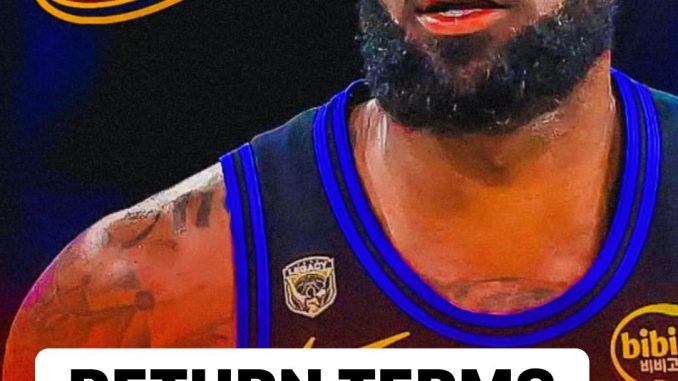
For nearly two decades, LeBron James has controlled the NBA’s offseason conversation like few athletes in sports history ever have. Even at 41 years old and entering what could be the final chapter of a legendary career, the future Hall of Famer remains the center of league-wide speculation. This time, however, the drama surrounding James is not only about where he might play next season — it is about how much he is willing to sacrifice financially in pursuit of one more championship run.
According to longtime ESPN insider Brian Windhorst, one of the biggest hurdles standing between James and a potential return to the Cleveland Cavaliers is money. Windhorst recently reported that while Cleveland could theoretically create a pathway to bring James home for a third stint, the four-time NBA champion is reportedly not interested in taking the kind of drastic pay cut that would currently be required. (Bleacher Report)
That revelation instantly sent shockwaves across the basketball world.
For months, rumors surrounding a possible reunion between James and Cleveland have intensified. Some insiders believed the possibility became even more realistic after James appeared to engage with social media content encouraging him to “come home” to Northeast Ohio. (People.com) Others pointed to the shifting direction of the Los Angeles Lakers, who appear increasingly focused on building around younger superstar Luka Dončić following their blockbuster organizational changes. (Fear The Sword)
But while fans fantasized about a storybook ending in Cleveland, Windhorst’s latest reporting offered a dose of reality.
“The Cavs, today, can sign LeBron for $3 million,” Windhorst reportedly said while discussing the financial mechanics involved in a reunion. “He made $54 million this year. To my knowledge, LeBron is not prepared to take that kind of pay cut.” (Bleacher Report)
That statement alone perfectly captures the tension surrounding James’ current position in the NBA landscape. On one hand, he remains one of the league’s most productive stars despite his age. On the other, salary-cap limitations make it extremely difficult for contenders to fit his contract onto an already expensive roster without significant restructuring.
For Cleveland specifically, the challenge is enormous.
The Cavaliers have built a talented core around Donovan Mitchell, Evan Mobley, and an increasingly competitive supporting cast that helped push the franchise back into legitimate Eastern Conference contention. Their recent playoff run, despite ending in disappointment against the New York Knicks, reinforced the belief that Cleveland is no longer rebuilding — it is trying to win immediately. (Reuters)
That is exactly why the LeBron speculation refuses to disappear.
James has repeatedly made it clear that winning remains his top priority. Reports indicate he is not interested in spending the final years of his career on a rebuilding team or in a situation lacking championship potential. (Reuters) Cleveland, unlike many franchises linked to him in rumors, actually offers a competitive roster capable of contending in the Eastern Conference.
There is also the emotional side of the story — one the NBA has never truly been able to escape.
James was born in Akron, Ohio. He was drafted first overall by Cleveland in 2003. He transformed the Cavaliers into contenders, left in one of the most controversial free-agency departures in sports history during “The Decision,” then returned in 2014 to deliver the franchise’s first NBA championship in 2016. (Wikipedia)
That 2016 title remains one of the defining moments in league history. Down 3-1 against the historically dominant Golden State Warriors, James led Cleveland to an improbable comeback that permanently changed his legacy. (Wikipedia)
Because of that history, every rumor involving James and the Cavaliers carries extra emotional weight. Fans are not simply debating basketball fit. They are debating destiny.
Could the greatest player in franchise history return home one final time?
Could Cleveland become the place where James closes the curtain on a 24-year career?
Could one final title chase unite the superstar and the city once again?
Those questions continue to dominate NBA discussions, especially as uncertainty grows around James’ long-term future with the Lakers.
Los Angeles still possesses financial advantages over virtually every potential competitor. Thanks to Bird Rights, the Lakers can offer James far more money than rival teams. (Reuters) However, the situation has become increasingly complicated as the franchise balances the future around Dončić while still attempting to maximize the final years of James’ career.
There are also basketball concerns.
Despite James continuing to post elite numbers, the Lakers once again fell short of championship expectations. Questions surrounding roster construction, depth, and long-term direction have only intensified. (Reuters) For a player who openly admitted he does not want to “start over,” every offseason decision now carries massive importance.
That is why the pay-cut discussion matters so much.
Throughout NBA history, veteran superstars nearing the end of their careers have occasionally sacrificed money to pursue championships. Fans naturally wonder why James, whose career earnings and business empire have already made him a billionaire, would not simply accept a reduced salary if it increased his chances of competing for another ring.
But the issue is more nuanced than public perception often suggests.
James has spent most of his career advocating for player empowerment and maximizing athlete value. Accepting a massive reduction — particularly one as steep as dropping from over $50 million annually to around $3 million — could set a precedent many star players and agents would view unfavorably.
Additionally, from James’ perspective, his production still justifies elite compensation.
Even in Year 23, he remains one of basketball’s most impactful players. He continues to generate enormous revenue, television ratings, ticket sales, sponsorship attention, and global visibility for whichever franchise he represents. To many around the league, the idea that James should suddenly accept a near-minimum contract simply because of his age ignores the reality of his continued value.
Still, critics immediately surfaced after Windhorst’s comments became public.
Some fans accused James of prioritizing money over winning. Others argued that if returning to Cleveland truly mattered emotionally, finances should not become an obstacle. Social media exploded with debate over whether James’ legacy would benefit more from one final title pursuit or from maximizing earnings late in his career. (X (formerly Twitter))
Yet there is another layer to the discussion that cannot be ignored: Cleveland itself may not even be in position to make the move easily.
The Cavaliers already face difficult financial decisions involving their current roster. Mitchell’s future extension looms large, while the organization must also carefully navigate long-term salary commitments around Mobley and the rest of the core. (Reuters) Bringing in James at anything close to a superstar salary would require significant restructuring, complicated sign-and-trade scenarios, or major roster sacrifices.
That raises an uncomfortable question for Cleveland fans: would acquiring a 41-year-old LeBron James actually improve the franchise enough to justify disrupting the current core?
Basketball-wise, the answer is complicated.
James would still elevate the Cavaliers offensively, particularly with his playmaking, leadership, and postseason experience. His ability to control tempo and create efficient offense remains elite. Pairing him with Mitchell and Mobley would instantly create one of the Eastern Conference’s most fascinating trios.
But there are legitimate concerns too.
Would Cleveland have enough depth left after maneuvering financially to acquire him? Would James accept a secondary role within a younger core? Could the Cavaliers realistically compete with emerging powers across the league while carrying the enormous expectations attached to a LeBron reunion?
Those uncertainties explain why league executives continue to view this situation cautiously despite the nonstop headlines.
Meanwhile, James himself has remained relatively measured publicly. Although he has fueled speculation indirectly through social media interactions, he has also consistently emphasized that winning is the priority above all else. (Reuters)
That focus on contention could ultimately determine everything.
If James believes Cleveland offers the best realistic opportunity to compete for another championship, creative solutions could emerge. Sign-and-trade possibilities, short-term deals, or roster adjustments may eventually reopen the door. But Windhorst’s reporting suggests one thing is becoming increasingly clear: James does not appear willing to dramatically undervalue himself financially just to make the reunion happen. (Bleacher Report)
And honestly, that stance may not surprise those who have followed his career closely.
From the beginning, James has approached his career not only as an athlete but as a businessman who understands leverage, market value, and long-term influence. Every contract decision he has made has reflected that awareness. Whether in Cleveland, Miami, or Los Angeles, James has consistently maintained pressure on organizations to remain competitive while protecting his earning power.
That philosophy helped redefine player mobility across the modern NBA.
It also helped create an era where superstars became increasingly comfortable controlling their own careers rather than relying entirely on franchise loyalty. James became the face of that movement, for better or worse depending on perspective.
Now, at the end of his career, he faces perhaps the most emotionally charged decision yet.
Does he stay in Los Angeles and continue pursuing championships alongside Dončić?
Does he seek another contender capable of maximizing his remaining years?
Or does he attempt one final Cleveland return, knowing the financial realities may complicate the romantic vision many fans desperately want to see?
At this moment, nobody truly knows.
But Windhorst’s report provided one of the clearest indications yet that sentimentality alone will not drive James’ next move. (Bleacher Report)
The NBA icon may love Cleveland. He may cherish his legacy there forever. He may even seriously consider returning someday.
Yet if a reunion is going to happen, it appears both sides will need to find a solution that respects not only the emotional significance of the moment but also the business realities attached to one of basketball’s biggest global stars.
And until that happens, the speculation will only continue growing louder.
Be the first to comment