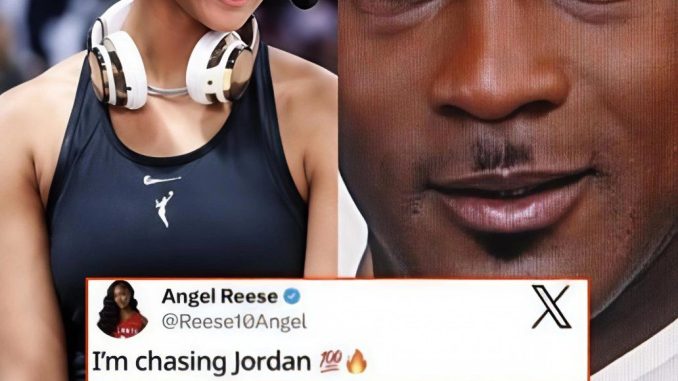
The NBA world and women’s basketball culture collided in a viral moment that quickly spiraled beyond the confines of sport, as Phoenix Suns superstar Kevin Durant fired back after a bold comment from LSU champion Angel Reese sparked intense debate across social media platforms. What began as a seemingly lighthearted exchange of opinions quickly evolved into a trending talking point that pulled in fans, analysts, and even former players, all weighing in on where the line sits between confidence, criticism, and competitive respect in modern basketball discourse.
The situation reportedly began when Reese made a candid remark during a media interaction that touched on NBA personalities, competitiveness, and the growing overlap between men’s and women’s basketball conversations online. While Reese has built her brand on unapologetic confidence and vocal self-belief, her comment—described by many fans as “bold” and “unfiltered”—was interpreted in multiple ways depending on perspective. Some saw it as playful commentary, others viewed it as unnecessary provocation toward one of the league’s most accomplished scorers in Durant.
Within hours, clips and reposts of the comment began circulating widely across X, Instagram, and TikTok, with fans dissecting every angle of her tone and intent. As the discussion intensified, Durant himself appeared to respond indirectly through social media activity that fans quickly interpreted as a subtle but pointed rebuttal. Known for his active presence online and his willingness to engage with narratives surrounding his name, Durant did not let the moment pass quietly.
The Suns forward, a two-time NBA champion and former league MVP, has long been one of the most scrutinized figures in basketball. Whether it’s his legacy discussions, team decisions, or social media interactions, Durant has consistently found himself at the center of basketball’s most heated conversations. This latest episode added another layer to that ongoing storyline, as his response—though not overtly aggressive—carried the weight of a veteran superstar who is fully aware of how narratives can be shaped in real time.
Fans immediately began debating whether Durant’s reaction was justified or whether the entire situation had been exaggerated by online amplification. Some argued that Reese’s comment was being taken out of context, pointing out that modern athletes often engage in cross-league banter that is meant more for entertainment than confrontation. Others felt Durant’s response reflected the natural pride of an all-time great who refuses to let his name be casually pulled into debates without acknowledgment.
What made the moment even more compelling was the intersection of two different basketball worlds. Reese, a rising face of the WNBA and one of the most marketable young athletes in sports, has embraced her role as a cultural figure as much as a player. Her presence extends far beyond the court, where she continues to shape conversations around women’s basketball visibility, media representation, and athlete empowerment. Durant, meanwhile, represents a different era of NBA superstardom—one defined by efficiency, scoring brilliance, and a digital-age relationship with fans that is often both direct and unpredictable.
As the discourse unfolded, analysts noted that this was less about conflict and more about the evolving ecosystem of sports media, where every comment can become a headline within minutes. In previous generations, Reese’s statement might have circulated in niche sports circles before fading. In today’s environment, however, it becomes a cross-platform narrative involving millions of fans who feel personally invested in interpreting tone, intent, and reaction.
Durant’s “fire back,” as described by fans online, was not a traditional press conference rebuttal or formal interview response. Instead, it reflected the modern athlete’s toolkit—subtle posts, reposts, emojis, and indirect messaging that allows them to engage without fully escalating a situation. That ambiguity is part of what keeps Durant at the center of attention; his responses are rarely loud, but they are often loud enough to spark further debate.
Reese, for her part, has not backed away from the attention. Throughout her career—from her NCAA championship run to her transition into the professional ranks—she has repeatedly embraced scrutiny as part of her identity. Rather than retreating from controversy, she often leans into it, using it as fuel for both performance and visibility. That approach has made her one of the most talked-about athletes in women’s basketball, but it also places her in the crosshairs of broader sports conversations that extend beyond her league.
The overlap between Durant and Reese in this moment highlights a larger cultural shift in basketball media. The walls between leagues, genders, and even sports are increasingly porous, with athletes now part of a shared global conversation rather than isolated ecosystems. A comment made in one setting can instantly be reframed through the lens of another, creating friction, humor, or debate depending on interpretation.
In Durant’s case, his reaction also reflects a long-standing theme in his career: sensitivity to perception versus intent. Few superstars in NBA history have been as consistently discussed online as Durant, whose every action is dissected through a microscope of fan opinion. From his early years with the Oklahoma City Thunder to his championship run with the Golden State Warriors and now his leadership role in Phoenix, Durant has navigated a public persona that is both admired and endlessly analyzed.
The Suns star has also never shied away from engaging directly with critics, a trait that has both endeared him to fans and occasionally fueled controversy. In this instance, however, his response appeared less about confrontation and more about setting a boundary—reminding audiences that even in an era of viral commentary, established greatness still commands respect.
Meanwhile, Reese’s growing influence ensures that her words will continue to carry weight well beyond women’s basketball circles. She has become a central figure in discussions about NIL culture, athlete branding, and the visibility of the WNBA. Every statement she makes is filtered through a lens of cultural significance, whether intentional or not. That reality has elevated her platform but also increased the scrutiny she faces when interacting with figures from other leagues.
As the story continued trending, fans created split narratives: one side defending Reese’s right to speak freely and another defending Durant’s right to respond. Memes, reaction videos, and analytical threads flooded timelines, turning a simple exchange into a full-blown sports media cycle. It was less about the specifics of the comment and more about what it represented—a collision of confidence, legacy, and modern sports communication.
Former players and media voices also weighed in, with some suggesting that the reaction cycle itself is proof of how far sports media has evolved. Athletes are no longer just competitors; they are content creators, public personalities, and cultural symbols whose words carry immediate digital consequences. In that sense, the Durant-Reese moment is less an isolated incident and more a snapshot of a broader transformation in how sports narratives are built.
Durant’s legacy, already cemented through championships, scoring titles, and international success, is unlikely to be affected by any single viral exchange. However, moments like this reinforce how deeply embedded he remains in the ongoing conversation around basketball culture. Even in offseason-style discourse or indirect commentary, his presence looms large.
For Reese, the episode adds another chapter to her rapidly evolving public profile. At just the beginning of her professional career, she is already navigating the complexities of fame, expectation, and scrutiny at a level few athletes experience so early. Her ability to remain central in conversations involving NBA stars speaks to the scale of her influence and the growing intersection between women’s and men’s basketball media spaces.
As the noise gradually settles, what remains is a familiar pattern in modern sports: a comment, a reaction, and a viral feedback loop that amplifies both. Durant and Reese may not have intended to create a headline-grabbing moment, but in today’s digital sports ecosystem, intent often matters less than impact.
And in this case, the impact was undeniable. A single bold remark and a measured superstar response turned into one of the most discussed basketball storylines of the moment, proving once again that in the age of instant reaction, no exchange—no matter how small—ever stays small for long.
Be the first to comment