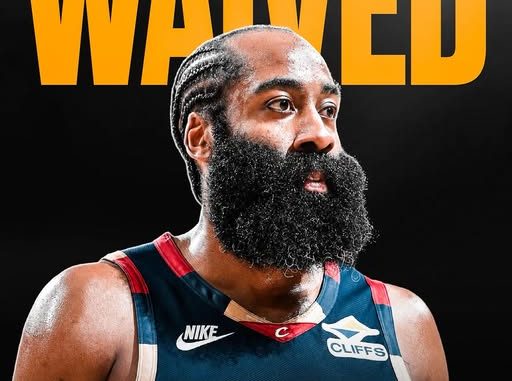
The fallout from the Cleveland Cavaliers’ humiliating Eastern Conference Finals collapse has already claimed its first major casualty, and few around the NBA expected it to happen this quickly. In a move that sent shockwaves throughout the basketball world, Cleveland officially waived former MVP James Harden less than 48 hours after the team’s season-ending sweep at the hands of the New York Knicks, signaling what many believe is the end of one of the most polarizing superstar eras in modern NBA history.
For a franchise that entered the postseason with championship aspirations, the decision felt both stunning and symbolic. Cleveland’s front office spent the better part of the season convincing fans and analysts alike that pairing Harden’s elite playmaking with the Cavaliers’ young core would elevate the team into a legitimate title contender. Instead, the experiment unraveled in brutal fashion on the biggest stage possible.
The Cavaliers’ final image of the 2026 season was painful enough on its own. A 130-93 blowout loss at home in Game 4 completed a humiliating sweep by New York and left Cleveland fans booing long before the final buzzer sounded. Jalen Brunson carved up Cleveland’s defense throughout the series, while Harden struggled to make a consistent impact offensively, finishing the elimination game with one of the quietest stat lines of his playoff career.
Now, the organization has made it clear that change is coming quickly.
League insiders described the Cavaliers’ decision as “organizational frustration reaching its breaking point.” Harden arrived in Cleveland with enormous expectations and the belief that his postseason experience could help guide a talented but relatively inexperienced roster through the pressure of deep playoff basketball. Instead, the Cavaliers appeared disconnected, stagnant offensively, and overwhelmed by the physicality and pace of the Knicks throughout the Eastern Conference Finals.
For Harden, the news marks another painful chapter in a career that has become increasingly defined by postseason disappointment despite historically brilliant regular-season accomplishments. The former MVP remains one of the most productive offensive guards the league has ever seen. His scoring titles, assist crowns, and revolutionary isolation-heavy style helped redefine modern NBA offense during his prime years with the Houston Rockets. Yet despite the accolades, the championship pursuit that has driven Harden for over a decade continues to slip further away.
What makes this moment especially emotional for longtime NBA observers is the symbolism attached to it. Harden was once considered untouchable — a perennial MVP candidate capable of carrying franchises on his back through sheer offensive genius. There was a time when opposing defenses looked helpless trying to contain his step-back three-pointer, crafty foul drawing, and elite court vision. In his prime, Harden was not merely productive; he was inevitable.
But time changes every superstar eventually.
The Cavaliers believed they were acquiring a veteran floor general who could stabilize playoff possessions and unlock easier scoring opportunities for Cleveland’s younger stars. During stretches of the regular season, that vision appeared realistic. Harden flashed moments of brilliance as a facilitator, controlling tempo and helping Cleveland maintain one of the Eastern Conference’s most efficient half-court offenses.
Yet the postseason exposed deeper issues.
Defensively, the Cavaliers struggled to contain New York’s relentless perimeter pressure. Offensively, the ball often stuck in Harden’s hands for too long, allowing the Knicks to dictate pace and force Cleveland into difficult late-clock situations. The contrast between Brunson’s aggression and Harden’s hesitancy became one of the defining storylines of the series.
As frustration mounted, criticism followed quickly.
Former players and analysts questioned whether Cleveland had become too dependent on aging star power rather than continuing to build around its younger foundation. Others argued that Harden simply no longer possessed the explosiveness necessary to consistently dominate elite playoff defenses. The conversation surrounding him shifted from “Can he still be a superstar?” to “What role can he realistically play on a championship team?”
That shift may ultimately define the next stage of Harden’s career.
Around the league, executives are already debating whether this is truly the end of Harden as a meaningful contender or merely the conclusion of his days as a centerpiece star. Some franchises may still view him as a valuable veteran creator capable of elevating bench units and mentoring younger guards. Others will undoubtedly hesitate, concerned about durability, defensive limitations, and the mounting history of postseason shortcomings.
The emotional weight of Cleveland’s decision extends beyond basketball strategy. Harden represents one of the defining talents of his generation, a player whose influence on offensive basketball is impossible to ignore. His ability to manipulate defenses, create efficient scoring opportunities, and orchestrate entire offenses changed the way teams evaluated perimeter stars. Younger players across the league modeled parts of their game after Harden’s footwork, pace control, and advanced understanding of spacing.
That legacy remains secure regardless of what happens next.
Still, moments like this are difficult because they force fans to confront the uncomfortable reality that basketball eras eventually end. The league moves quickly. Yesterday’s unstoppable superstar can become today’s difficult roster question almost overnight. For many fans who watched Harden dominate throughout the 2010s, seeing him waived after a conference finals defeat feels surreal.
Social media erupted immediately following the announcement. Some fans expressed disappointment that Harden’s championship pursuit may be slipping away permanently. Others argued the Cavaliers had little choice after such a disastrous playoff showing. The debate quickly expanded into larger conversations about Harden’s place in NBA history.
Critics pointed to repeated postseason collapses throughout his career, referencing difficult exits with Houston, the Brooklyn Nets, the Philadelphia 76ers, and now Cleveland. Supporters countered by highlighting Harden’s longevity, durability during his prime years, and statistical achievements that place him among the greatest offensive players ever.
The truth likely exists somewhere in between.
Harden’s legacy has always been uniquely complicated. Few players in league history have combined his regular-season production with such polarizing playoff narratives. He revolutionized offensive efficiency, won an MVP award, and consistently carried undermanned rosters deep into the postseason. Yet because championships often dominate historical conversations, his inability to capture a title continues to overshadow much of what he accomplished individually.
For Cleveland, the move signals a dramatic pivot toward the future.
The organization now faces enormous questions regarding roster construction, leadership, and overall direction. The Cavaliers entered this season believing they were close to competing for a championship. Instead, their season ended with public embarrassment and immediate organizational upheaval.
Sources around the league expect Cleveland’s front office to prioritize youth, athleticism, and defensive versatility moving forward. The Knicks exposed glaring weaknesses in Cleveland’s perimeter defense and transition coverage, areas the Cavaliers are expected to address aggressively this offseason.
The timing of Harden’s release also suggests the franchise wants to create financial flexibility before free agency begins. Waiving a high-profile veteran this quickly after elimination demonstrates urgency — and perhaps impatience — from ownership and management alike.
Meanwhile, Harden’s next destination instantly becomes one of the most fascinating storylines of the upcoming offseason.
Will a contender take a chance on him as a veteran sixth man? Could a rebuilding team pursue him primarily for mentorship and ticket sales? Or is there a possibility Harden explores opportunities overseas should NBA interest prove less aggressive than expected?
Several league executives reportedly believe Harden still possesses enough offensive creativity to contribute meaningfully in the right situation. His basketball IQ remains elite, and even diminished athleticism has not erased his passing instincts or ability to manipulate defenders in pick-and-roll situations.
However, the margin for error has changed dramatically.
At this stage of his career, Harden can no longer dominate physically the way he once did. Teams evaluating him must determine whether his strengths outweigh the defensive challenges and ball-dominant tendencies that have increasingly drawn criticism in recent years.
For many NBA fans, though, the immediate reaction was less about contracts or roster mechanics and more about emotion.
Because regardless of where one stands on Harden’s legacy, there is no denying his impact on the sport. He helped define an era built around spacing, three-point shooting, and isolation scoring. He delivered unforgettable performances, iconic moments, and statistical explosions that once seemed impossible for a perimeter player.
His 60-point triple-double remains one of the most absurd individual games in league history. His scoring streaks during his Houston prime felt almost fictional at times. Night after night, Harden bent defenses to his will and forced the league to adapt to his style.
Players of that caliber rarely disappear gracefully.
Instead, the decline often arrives publicly and painfully, magnified by playoff losses and shifting narratives. One year a player is viewed as indispensable. The next, teams begin discussing flexibility, chemistry, and future direction.
That reality is what makes Cleveland’s decision resonate so strongly across the basketball world.
The Cavaliers did not merely waive a veteran player. They effectively closed the door on one of the NBA’s most fascinating superstar journeys — at least in its current form. Whether Harden finds another opportunity remains to be seen, but this moment undeniably feels like the end of something larger.
An era.
For younger fans, Harden may ultimately be remembered as the brilliant but controversial scorer who never quite captured the championship that would have silenced critics permanently. For others, especially those who watched his prime closely, he will be remembered as one of the most gifted offensive engines the sport has ever produced.
Both perspectives can be true simultaneously.
As the NBA prepares for another offseason full of blockbuster rumors and franchise-altering decisions, Harden’s uncertain future now hangs over the league like a lingering question mark. Somewhere, another team may still believe there is meaningful basketball left in one of the greatest guards of his generation.
But after Cleveland’s stunning decision, one thing feels undeniable: the aura surrounding James Harden has changed forever.
And in a league built on constant evolution, that may be the clearest sign yet that basketball’s next era has already begun.
Be the first to comment