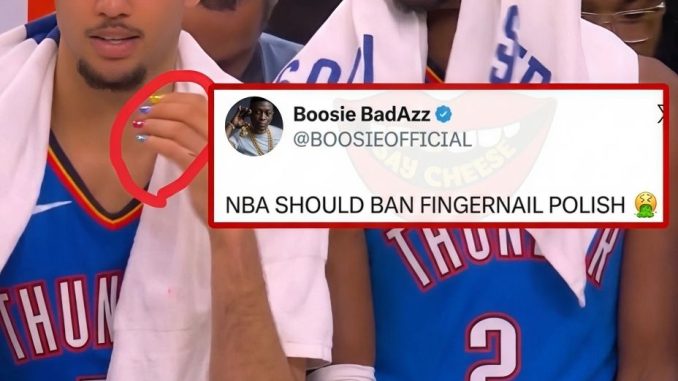
What started as another off-court social media flare-up quickly spiraled into a full-blown cultural talking point around the league on Tuesday, after rapper Boosie Badazz publicly called for the National Basketball Association to ban nail polish, arguing that courtside aesthetics have drifted too far into what he described as “a distraction era” of professional basketball. What might have once been dismissed as internet noise instead tapped into a broader, ongoing debate about NBA entertainment culture, player branding, and the increasingly visible intersection between fashion, celebrity influence, and the game itself.
Boosie’s comments, delivered in a livestream that quickly circulated across social platforms, were as blunt as they were polarizing. He questioned what he sees as a growing emphasis on courtside style over basketball purity, singling out brightly colored nail designs frequently visible among players, celebrities, and influencers seated near the hardwood. While the remarks were not made through any formal channel, their timing—amid a postseason stretch already saturated with storyline-heavy narratives—ensured they would not fade quietly.
“I don’t want to see that in the NBA,” Boosie said during the stream, referring to nail polish aesthetics he believes are inconsistent with his vision of the league’s image. The comment, stripped from context and reposted in short clips, immediately ignited reactions ranging from ridicule to defense, with fans, media figures, and former players weighing in across X, Instagram, and sports talk shows.
At its core, the controversy is not actually about nail polish. It is about what the NBA represents in 2026: a league where fashion, identity, and self-expression have become inseparable from the product on the court. Players walk into arenas in runway-level outfits. Tunnel fits are dissected like game film. Courtside seats are occupied by musicians, influencers, actors, and athletes from other sports who often generate as much attention as the game itself.
For critics like Boosie, this evolution represents a departure from a more traditional vision of professional basketball—one centered almost exclusively on competition, team identity, and on-court discipline. For supporters of the modern NBA aesthetic, however, the league’s cultural expansion is precisely what has elevated it into a global entertainment powerhouse.
The tension between those two perspectives is not new, but Boosie’s specific framing—centering something as seemingly minor as nail polish—has given the discussion an unusual focal point. In basketball culture, symbolism matters. Fashion choices, hairstyles, tattoos, and even pregame routines are often interpreted as extensions of personality or statements about the league’s broader identity. Nail polish, in this context, becomes less about cosmetics and more about what visibility and expression mean in a highly televised sport.
Within hours of Boosie’s remarks going viral, current and former players began reacting indirectly. Some dismissed the comments as irrelevant to the sport’s competitive reality, while others joked about the unexpected nature of the criticism. A number of analysts pointed out that the NBA has historically embraced individuality, from Allen Iverson’s iconic fashion statements to Dennis Rodman’s constantly evolving visual identity. In that sense, the league’s culture has never been static—and certainly not resistant to personal expression.
Still, Boosie’s critique found traction among a subset of fans who believe the NBA has leaned too heavily into entertainment branding at the expense of “pure basketball.” That phrase—often loosely defined—typically refers to a desire for less emphasis on off-court spectacle and more focus on fundamentals, rivalries, and team identity. The nail polish debate, though unconventional, became a symbolic proxy for that broader dissatisfaction.
The league itself has not issued any response, and there is no indication that such a policy suggestion would be considered in any formal capacity. The NBA’s approach in recent years has leaned heavily toward embracing cultural integration rather than restricting it. From fashion partnerships to player-led media ventures, the league has consistently positioned itself at the intersection of sport and lifestyle branding.
But what makes this moment particularly notable is not the feasibility of Boosie’s suggestion—it is the speed at which it captured attention in a media ecosystem where viral takes often compete with actual game coverage for dominance. In many ways, the controversy says less about nail polish and more about the attention economy surrounding the NBA.
Courtside culture has evolved dramatically over the past two decades. Where once celebrity attendance was a novelty, it is now a consistent feature of broadcast presentations. Networks routinely cut to high-profile attendees during key moments, and social media amplifies those appearances within seconds. Fashion choices among those attendees—down to accessories and grooming details—become part of the broader spectacle.
That visibility has fueled both admiration and criticism. On one hand, it enhances the NBA’s status as a cultural hub. On the other, it invites scrutiny from those who feel the game itself risks being overshadowed by its surrounding ecosystem. Boosie’s comments, intentionally or not, inserted themselves directly into that ongoing tension.
Interestingly, the reaction also revealed how quickly sports discourse can fracture along generational and cultural lines. Younger fans largely treated the statement as satire or irrelevance, while some older or more traditional viewers engaged with it more seriously. In between, commentators attempted to translate the moment into a broader discussion about authenticity in sports entertainment.
Some analysts drew comparisons to previous debates around dress codes, which the NBA implemented in the mid-2000s in an attempt to standardize player appearances. That policy itself was controversial at the time and is now often referenced as a turning point in how the league managed image versus individuality. In hindsight, many of the same arguments resurfacing today were already present then—just expressed through different cultural symbols.
What separates the current moment is the speed and scale of amplification. A single livestream comment can now evolve into a league-wide talking point within hours, regardless of whether it originates from a player, celebrity, or outside commentator. In this case, Boosie’s status as a musician with a strong public persona ensured that his remarks traveled far beyond their initial audience.
The NBA, for its part, continues to operate in a space where cultural relevance is not optional—it is foundational. The league’s global reach depends not only on the quality of basketball but also on its ability to remain embedded in music, fashion, and digital culture. That interconnectedness is precisely what makes debates like this so persistent and difficult to resolve.
As postseason intensity continues on the court, the off-court conversation underscores a familiar reality: modern basketball is no longer just a sport. It is a content ecosystem where every detail—down to nail polish—can become symbolic currency in a larger debate about identity, values, and evolution.
Whether Boosie’s comments fade as another viral moment or evolve into a longer cultural conversation will depend less on the league and more on the internet’s appetite for the topic. But in the meantime, the NBA finds itself once again at the center of a discussion it did not ask for, yet cannot fully escape.
And as history has shown, in today’s NBA, even the smallest aesthetic choices can ignite the biggest conversations.
Be the first to comment