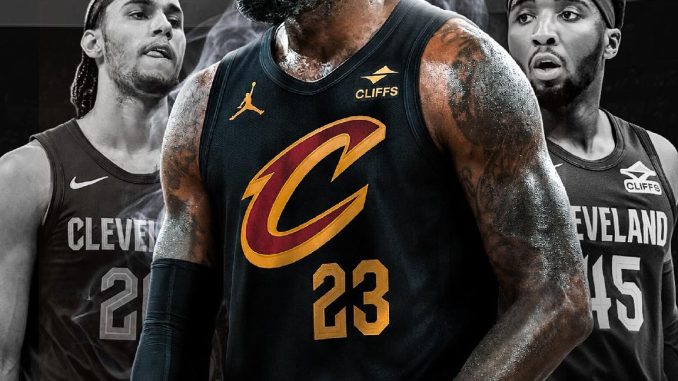
The debate around the face of the Cleveland Cavaliers franchise was reignited this week after rising young guard Jaylon Tyson made comments many fans interpreted as a declaration that the city now belongs to superstar Donovan Mitchell. While Tyson’s remarks were likely intended as praise for the Cavaliers’ current leader and the man who has carried Cleveland deep into championship contention once again, the statement quickly sparked passionate reactions across the basketball world because of one unavoidable reality: no player has ever defined Cleveland basketball the way LeBron James did.
In today’s NBA, every generation of fans wants to identify the next era, the next franchise icon, and the next superstar capable of placing a city on the map. Mitchell has unquestionably earned admiration since arriving in Cleveland. His scoring explosions, leadership, and postseason performances have transformed the Cavaliers into one of the Eastern Conference’s most dangerous teams. But when Tyson reportedly referred to Cleveland as “Donovan Mitchell’s city,” many immediately viewed the comment as a challenge to the towering legacy LeBron left behind.
For Cavaliers fans, the subject is emotional because LeBron’s connection to the franchise was never simply about statistics. It was about identity. Before LeBron arrived as the No. 1 overall pick in the 2003 NBA Draft, Cleveland had experienced decades of frustration, heartbreak, and near-misses. The organization had seen talented players come and go, but none who could elevate the franchise into the center of the basketball universe. Then came the hometown phenom from nearby Akron, carrying impossible expectations before he had even played an NBA game.
LeBron not only met those expectations — he exceeded them in ways few athletes in professional sports history ever have. From his earliest seasons, he transformed the Cavaliers from an afterthought into a perennial contender. Sellout crowds became routine. National television appearances increased. Cleveland suddenly mattered on the biggest stage because LeBron made it matter.
The first chapter of LeBron’s Cavaliers career culminated in the unforgettable 2007 playoff run when he carried an undermanned roster all the way to the NBA Finals. Although Cleveland ultimately fell to the San Antonio Spurs, the image of a 22-year-old LeBron dismantling elite defenses and announcing himself as the league’s next global superstar remains one of the defining moments in Cavaliers history.
Even after his departure to the Miami Heat in 2010, LeBron’s shadow never truly left Cleveland. The franchise collapsed into the lottery years without him, further proving how much of the Cavaliers’ identity had been tied directly to his greatness. His return in 2014 instantly changed everything again. Expectations skyrocketed overnight, and Cleveland became championship-or-bust.
What followed cemented LeBron’s place not only in Cavaliers history, but in sports history as a whole. The 2016 NBA Finals remain one of the most iconic championship series ever played. Facing the record-setting 73-win Golden State Warriors, the Cavaliers fell behind 3-1 and appeared finished. No team had ever recovered from such a deficit in the NBA Finals. Then LeBron authored perhaps the greatest three-game stretch of basketball ever seen.
His legendary chase-down block on Andre Iguodala in Game 7 became an immortal sports moment. His emotional reaction after delivering Cleveland its first major professional sports championship in more than 50 years became permanently etched into the city’s cultural identity. In that instant, LeBron was no longer simply a basketball star. He became synonymous with Cleveland itself.
That is why Tyson’s comment generated such immediate pushback online. Fans were not necessarily criticizing Mitchell. In fact, most acknowledged Mitchell has been brilliant since joining the Cavaliers. The issue was the implication that anyone could already surpass or replace the emotional ownership LeBron established through two separate eras with the franchise.
Mitchell, to his credit, has never appeared interested in competing with LeBron’s legacy. If anything, he has consistently shown respect for what James accomplished in Cleveland. Since arriving from the Utah Jazz, Mitchell has embraced the responsibility of leading a proud franchise while understanding the historical weight attached to it.
His impact has nevertheless been enormous. Cleveland acquired Mitchell to become a legitimate contender, and he delivered immediately. His scoring ability gave the Cavaliers a true closer in high-pressure situations. His explosiveness offensively elevated the team from promising young squad to feared postseason opponent. Mitchell’s performances this season, particularly during Cleveland’s deep playoff push, have strengthened his standing among the NBA’s elite guards.
The Cavaliers’ current postseason journey has only intensified discussions surrounding the team’s modern identity. Cleveland entered the Eastern Conference Finals carrying enormous momentum, fueled by Mitchell’s leadership and a balanced roster built around youth, defense, and star power. However, their series against the New York Knicks has exposed the brutal difficulty of postseason basketball at the highest level.
After falling behind 3-0 in the series, the Cavaliers now face enormous pressure entering Game 4 in Cleveland tonight.
Mitchell has continued to battle despite the deficit, but the comparisons to LeBron inevitably surface during moments like these because James repeatedly carried Cleveland through impossible playoff circumstances during his tenure. Whether it was eliminating heavily favored opponents, producing historic statistical performances, or dragging depleted rosters deep into the postseason, LeBron established a standard of postseason excellence that still hangs over every Cavaliers star who follows him.
That does not mean Mitchell should be judged unfairly against one of the greatest players in basketball history. Few athletes in any sport could survive that comparison. But it does explain why fans reacted strongly to Tyson’s wording. In Cleveland, LeBron’s legacy is not simply part of franchise history — it is the franchise history.
Tyson himself likely never intended to create controversy. The rookie has shown confidence and maturity throughout his early NBA experience, and his comments appeared rooted more in admiration for Mitchell’s leadership than any attempt to diminish LeBron’s accomplishments. Younger players naturally gravitate toward the current locker room leader, especially someone as respected around the league as Mitchell.
Still, in today’s social media era, every phrase becomes magnified. Fans immediately dissected Tyson’s statement, with many arguing that Cleveland can appreciate Mitchell’s greatness without erasing the historical context surrounding LeBron’s unprecedented achievements. Others defended Tyson by pointing out that sports evolve through eras and that Mitchell represents the current face of the franchise regardless of past legends.
There is truth to both perspectives. Mitchell is undeniably the centerpiece of today’s Cavaliers. His jersey fills arenas. His highlights dominate broadcasts. Young fans growing up during this era may ultimately associate the current Cavaliers more with Mitchell than with LeBron because sports memories are often generational. That is the natural cycle of professional athletics.
But there is also a difference between being the current star and being the defining icon of a franchise’s entire existence. In Cleveland, that distinction still belongs overwhelmingly to LeBron.
Statistically, emotionally, culturally, and historically, his résumé with the Cavaliers remains unmatched. He is the franchise’s all-time leader in virtually every major category. He delivered the organization’s only championship. He transformed Cleveland into a global basketball destination twice. Even years after his departure, discussions about the Cavaliers still routinely begin with his name because his influence remains impossible to separate from the organization’s identity.
The debate also highlights an interesting challenge modern stars face when following transcendent legends. Mitchell can build an extraordinary Cavaliers legacy and still never eclipse LeBron’s impact in the eyes of many fans. That is not a criticism of Mitchell. It is simply the reality of following a player widely considered one of the two greatest basketball players ever alongside Michael Jordan.
Yet Mitchell’s story in Cleveland is still being written. Championships change narratives. Sustained success changes perception. If Mitchell eventually leads the Cavaliers to another NBA title, conversations around his place in franchise history would evolve dramatically. Cleveland fans are passionate, loyal, and deeply appreciative of stars who embrace the city wholeheartedly. Mitchell has already earned significant admiration for doing exactly that.
At the same time, many longtime fans believe LeBron’s connection to Cleveland transcends basketball achievements alone. He represented hope for a city that often felt overlooked nationally. He carried the emotional weight of expectations from childhood through superstardom. He fulfilled a promise by bringing a championship home. That relationship between athlete and city is extraordinarily rare in professional sports.
As the Cavaliers attempt to keep their season alive against New York, Tyson’s comments have unintentionally reignited larger conversations about legacy, loyalty, and greatness in Cleveland sports history. They have also reminded everyone how powerful LeBron’s imprint on the franchise still remains even years after he last wore a Cavaliers uniform.
Mitchell continues to lead the present. His performances, leadership, and commitment have restored Cleveland’s relevance among the NBA elite. He deserves recognition for helping shape a new competitive era for the franchise. Tyson’s praise reflects the respect Mitchell commands inside the locker room and throughout the organization.
But when conversations shift toward ownership of the city itself, emotions inevitably intensify because LeBron’s legacy in Cleveland exists on a different level entirely. His story with the Cavaliers became larger than basketball. It became part of the city’s identity, sports culture, and collective memory.
That is why one simple comment generated so much discussion across the NBA landscape. It was never truly about criticizing Mitchell or attacking Tyson. It was about protecting the legacy of a player who gave Cleveland its most unforgettable sports moments and forever changed how the basketball world viewed the Cavaliers franchise.
And until another superstar delivers something remotely comparable to what LeBron accomplished in Cleveland, many fans will continue believing there is only one player who can truly claim the city as his own.
Be the first to comment