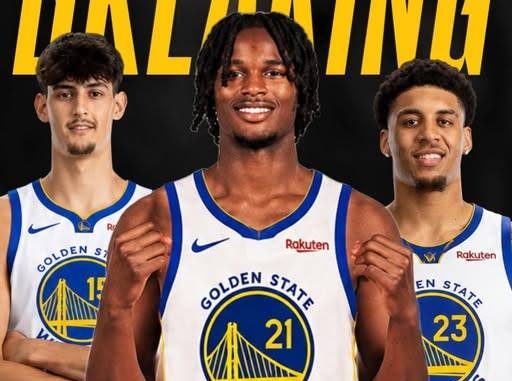
With the NBA Draft approaching and the board expected to shift dramatically in the final days leading up to selection night, the Golden State Warriors are reportedly refining a contingency-based strategy at pick No. 11—one that reflects both urgency and flexibility in a draft class defined by size, unpredictability, and a thin margin between high-upside swings and ready-made contributors.
According to league chatter circulating around front-office circles, the Warriors are seriously evaluating Illinois big man Morez Johnson Jr. as a potential fallback option if their preferred targets—UCLA’s towering center Aday Mara and UAB forward Yaxel Lendeborg—are off the board before they are on the clock.
It is not a revelation that Golden State is hunting size. It is, instead, a confirmation of what has become increasingly obvious over the past two seasons: the franchise that once defined modern basketball spacing and pace is now trying to solve the other side of its evolution problem. The Warriors have championship DNA, elite shooting gravity anchored by Stephen Curry, and a system still capable of bending defenses in ways few teams can replicate. But what they have lacked—consistently, and sometimes painfully—is functional, durable interior presence that can defend the rim, rebound in traffic, and survive the physical grind of postseason basketball.
This is why the draft conversation at No. 11 has become so center-heavy for Golden State. While perimeter talent always remains in play for a franchise built on guard play and motion offense, the internal evaluation has reportedly tilted toward players who can immediately change the geometry of their defense. Mara, Lendeborg, and Johnson all fit that broad archetype in different ways, but the distinctions between them are exactly what is shaping the Warriors’ contingency planning.
Mara represents the purest size gamble. At 7-foot-3, his frame and length immediately stand out even in a league where seven-footers are increasingly common. He is not just tall; he alters sightlines. His presence in the paint forces adjustments in shot selection, passing angles, and pick-and-roll coverage. For Golden State, a player like Mara would represent a dramatic departure from their traditional preference for switchable, mobile bigs. He is more of a positional anchor than a roaming disruptor. The appeal, however, is obvious: the Warriors have not consistently had a vertical deterrent of his size since the early years of their dynasty run.
Lendeborg, meanwhile, offers a more modern interpretation of frontcourt utility. At UAB, he has built a reputation as a high-energy, multi-positional forward who rebounds aggressively, handles the ball in transition, and defends across multiple assignments. His game is less about overwhelming physical stature and more about disruptive versatility. In a Warriors system that values quick decision-making and connective passing, Lendeborg’s ability to function as a secondary playmaker and defensive rover is an attractive proposition. He does not solve the “rim protector” question in the traditional sense, but he adds layers to defensive coverage and transition offense that Golden State has often leaned on in its most successful years.
Then there is Johnson, the name now emerging as a potential insurance policy if the board breaks unfavorably. Unlike the other two, Johnson’s profile sits somewhere between traditional and modern. At Illinois, he has shown flashes of interior scoring, rebounding toughness, and defensive instincts that translate to the next level without requiring a massive developmental leap in role definition. He is not the most hyped name in the lottery conversation, but within draft rooms, that distinction matters less than projection fit and clarity of pathway.
For the Warriors, Johnson reportedly represents stability in uncertainty. If Mara and Lendeborg are selected ahead of them—as several mock draft scenarios currently suggest—the franchise would still have an option that aligns with its most pressing roster need: a physically reliable frontcourt presence who can contribute without requiring the offense to be restructured around him.
What makes this draft particularly interesting for Golden State is the tension between timeline and identity. The franchise is not in a full rebuild, but it is no longer in the unquestioned peak phase of its dynasty either. The championship core has aged into a different competitive window, one where supporting cast decisions matter more than ever. Every rotation piece now carries amplified importance because the margin for error has narrowed.
This is why the No. 11 pick is being treated less as a luxury selection and more as a strategic pivot point. Golden State is not just drafting for talent; it is drafting for fit in a system that still expects to contend. That expectation creates a complicated evaluation matrix. A high-upside guard who may need two years to develop could be less valuable than a less flashy big who can absorb 15–20 minutes per night by midseason. Conversely, a conservative pick could limit the ceiling of the roster if the Warriors still believe they have one more championship window with Stephen Curry as the focal point.
League executives familiar with Golden State’s draft tendencies have often noted that the franchise prefers players who process the game quickly. IQ, defensive communication, and adaptability tend to outweigh raw athletic upside unless the latter is considered elite. That philosophy is what makes Johnson’s rising consideration particularly notable. While he may not have the same immediate star projection as some other lottery-adjacent names, his ability to fit within structured defensive schemes is reportedly viewed as a key advantage.
The Warriors’ internal draft discussions are also being shaped by broader league trends. The modern NBA has placed increasing value on size that can either stretch the floor or anchor the paint without compromising switching schemes. Teams are no longer looking for one-dimensional centers. They want players who can survive in space, protect the rim, and make quick reads under pressure. That balance is rare, which is why the draft board at the top of the lottery is expected to be unpredictable.
In that context, Mara’s uniqueness becomes both his strength and his question mark. There are very few players in the league who physically resemble him, and even fewer who enter the NBA with his combination of height and developing skill set. But the Warriors must weigh whether his style aligns with the pace and spacing demands of their system. He could be a long-term developmental anchor—or a positional outlier that requires constant scheme adjustments.
Lendeborg presents a different calculus. His floor may be higher in terms of immediate contribution, particularly in transition and defensive switching. But his ceiling depends heavily on whether his offensive game expands enough to punish teams that collapse into the paint. For Golden State, which often generates offense through movement rather than isolation scoring, that evolution is not mandatory—but it is highly beneficial.
Johnson, as the fallback, sits in the middle of those two extremes. He is not the tallest, not the most versatile, and not necessarily the most polished offensive player among the trio. But what he offers is reliability in a role that the Warriors have struggled to stabilize: physical interior defense with enough offensive awareness to avoid becoming a liability in playoff rotations.
The “insurance plan” framing of Johnson’s candidacy is important. It suggests that Golden State is not locked into a single direction, but instead preparing for multiple draft scenarios. This is typical of modern front offices, but it carries particular weight for a team operating under championship expectations. A misread at No. 11 could have ripple effects on both short-term competitiveness and long-term roster construction.
There is also the financial dimension to consider. Rookie-scale contracts for lottery picks remain one of the most valuable assets in the NBA. For a team like Golden State, which has navigated luxury tax constraints in recent seasons, maximizing value at this pick is as important as maximizing talent. A cost-controlled contributor in the frontcourt would allow the franchise greater flexibility in free agency and trade markets, where it has often been active in searching for complementary pieces around Curry, Klay Thompson, and Draymond Green.
That financial flexibility is part of why the Warriors are believed to be emphasizing readiness over raw projection. A player who can step into a rotational role within the first season effectively functions as both a roster upgrade and a cap-management tool.
Still, the draft is rarely linear. Workouts, medical evaluations, and private interviews can dramatically alter boards in the final week. It is entirely possible that one of Mara or Lendeborg slips further than expected, or that another team outside the top 10 creates a surprise selection that reshapes Golden State’s decision tree entirely. That uncertainty is precisely why “insurance plans” exist in front offices: not as commitments, but as prepared responses.
For now, the Warriors appear to be balancing ambition with pragmatism. Mara represents the swing for size dominance. Lendeborg represents the modern two-way connector. Johnson represents the stabilizing presence who may not redefine the franchise’s identity but could solidify a critical rotational weakness that has lingered for seasons.
As draft night approaches, Golden State’s decision at No. 11 will likely come down to which version of its future it prioritizes: maximum upside, positional versatility, or immediate reliability. In a league where windows open and close quickly, and where dynasty teams are measured not only by their stars but by the precision of their supporting cast, that choice may prove more consequential than it appears on paper.
What is already clear is that the Warriors are not entering this draft unprepared. They are entering it with options, hierarchy, and a defined understanding of their needs. And in a draft class where clarity is scarce, that alone may be their most valuable asset.
Be the first to comment