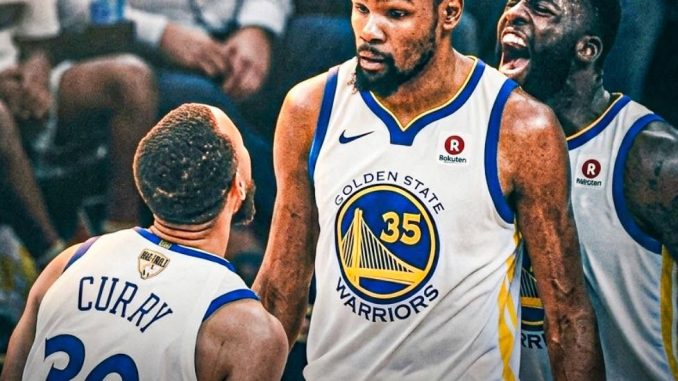
Eight years ago today, the NBA Finals delivered one of the most defining individual performances of the modern era, as Kevin Durant authored a 43-point masterpiece to lift the Golden State Warriors past the Cleveland Cavaliers and into commanding control of the 2017 championship series with a 118–113 Game 3 victory that shifted the entire balance of power on basketball’s biggest stage.
It was a night that felt preordained in its stakes but still unfolded with the kind of inevitability only great players can impose when the spotlight is brightest. The series had arrived in Cleveland tied in tension if not in record, but everything about Game 3 carried the weight of a turning point. The Cavaliers had returned home needing a statement. Instead, they were met with a force of offensive precision and shot-making brilliance that would define the rest of the series.
From the opening minutes, Durant did not play like a new addition to a championship team still finding its identity. He played like the missing piece who had already decided the outcome months earlier. Every possession seemed to bend toward his rhythm. When Cleveland switched defenders, he rose over them. When they stayed attached, he drifted into space and punished them. When help arrived, it came too late or from too far away. There was no comfortable answer, only degrees of difficulty he steadily overcame.
What made Durant’s performance so devastating was not just the scoring total, but the manner in which it came. This was not a barrage of low-percentage shots falling in streaks. It was a controlled dismantling of defensive schemes. Mid-range pull-ups from his sweet spots. Smooth catch-and-shoot threes that punished hesitation. Drives where he absorbed contact and still finished with soft touch. And in transition, long strides that turned defensive rebounds into immediate points before Cleveland could even organize.
The Cavaliers, led by LeBron James, attempted every available adjustment. They tried switching, trapping, and crowding the ball early. They tried forcing Durant to pass out of doubles and live with Golden State’s secondary options. But the problem they encountered was that Durant did not relinquish control easily. When the ball found him in space, he made decisions instantly. When it found him under pressure, he still found separation. And when the Warriors needed a basket to silence a Cleveland run, it almost always came through him.
The first half set the tone. Durant’s scoring came in waves, but the underlying theme was efficiency without hesitation. He was not searching for rhythm; he was dictating it. The Cavaliers, meanwhile, were trying to match pace with a Warriors team that thrived on spacing and ball movement. Every defensive lapse against Golden State was magnified by the fact that Durant was waiting at the end of possessions like a final exam Cleveland could not pass.
By halftime, the energy inside the arena reflected a familiar unease for the Cavaliers. They were not being overwhelmed by chaos; they were being dismantled by structure. The Warriors’ offense flowed through multiple hands, but Durant was the gravitational center. Even when he was not scoring, his presence bent the floor, pulling defenders into uncomfortable positions and opening lanes for teammates.
One of the defining sequences came late in the third quarter, when Cleveland briefly threatened to swing momentum. A run fueled by hustle plays and aggressive defense cut into Golden State’s lead and ignited the crowd. In earlier Finals between these two teams, such moments had often spiraled into sustained Cavaliers surges. But this time, Durant responded personally.
He isolated, rose over contested coverage, and buried a jumper with the kind of calm that deflates momentum as much as it builds it. On the next possession, he attacked again. And again. Within minutes, Cleveland’s run had been neutralized not by scheme or rotation, but by shot-making at an elite, unguardable level.
What separated this performance from even Durant’s other great playoff nights was the timing of his answers. Every Cavaliers push was met with immediate counterpunches. It wasn’t just that he scored 43 points; it was when he scored them. Each bucket felt like it arrived precisely when Cleveland needed a stop most, only for Durant to deny them that release.
The Warriors, under pressure to validate their star-heavy construction after Durant’s arrival, leaned into what made them historically dangerous: spacing, pace, and trust in individual brilliance within a collective system. Stephen Curry orchestrated stretches of offensive flow that forced Cleveland’s defense to expand beyond its comfort zone, while Durant operated as the finishing blade. The combination created a dilemma the Cavaliers never fully solved—choose between containing movement or containing the most efficient scorer on the floor. They could not do both.
As the fourth quarter unfolded, the game tightened into a familiar Finals script: possession-by-possession pressure, every shot magnified, every defensive breakdown potentially decisive. Cleveland, backed by its home crowd and LeBron’s relentless drive, continued to fight into every margin. But each time the door seemed slightly ajar, Durant stepped through it and shut it again from the other side.
Midway through the final period, he delivered one of the game’s defining sequences. With the Cavaliers closing the gap and momentum threatening to tilt, Durant calmly created separation at the wing, rose into a contested jumper, and drained it without visible strain. The shot did not just extend the lead; it altered the emotional temperature of the game. It reminded Cleveland that there was no possession in which Durant could be safely contained.
Defensively, the Warriors also tightened their grip. While Durant’s scoring understandably headlines the night, Golden State’s ability to limit easy opportunities late ensured that his production translated into victory rather than mere brilliance in defeat. The Cavaliers were forced into difficult looks, contested drives, and late-clock improvisation that rarely yielded clean results. The margin between execution and exhaustion grew narrower with each passing minute.
As the final stretch arrived, the Cavaliers attempted one last surge. LeBron attacked relentlessly, carving through gaps and forcing rotations. But every time Cleveland threatened to fully close the gap, Durant answered again. A jumper here. A transition finish there. A possession where his length disrupted passing lanes and turned defense into offense.
By the final minute, the inevitability of Golden State’s victory had settled over the arena. The Warriors were not just ahead; they were in control of every emotional lever in the game. When the final buzzer sounded on the 118–113 result, the scoreboard confirmed what the eye test had been revealing for nearly three quarters of decisive basketball: this was Durant’s night in every sense that matters in the Finals.
His 43-point outburst was not simply a statistical achievement. It was a declaration of fit, dominance, and postseason inevitability. It validated the Warriors’ bold acquisition of a superstar who did not disrupt their system but elevated its ceiling beyond anything previously imagined. And it placed the Cavaliers in a near-impossible position, down 3–0 in the series against a team now fully synchronized around an unstoppable scoring force.
The broader legacy of that Game 3 extends beyond the box score. It marked the moment the 2017 Finals ceased to be a competitive series and became a showcase of historical offensive alignment. The Cavaliers would continue to fight, but the psychological edge had shifted irreversibly. Golden State had not just taken control of the series; they had revealed a level of offensive inevitability that few teams in NBA history have ever been able to match.
For Durant, it was a signature Finals performance that added clarity to his decision to join the Warriors. Critics had questioned fit, balance, and hierarchy. On that night, none of those concerns mattered. He was not a secondary option or a complementary piece. He was the primary answer to every defensive question Cleveland posed.
The Warriors would go on to complete their championship run, but Game 3 in Cleveland remains one of the defining pillars of that title. It encapsulated everything that made that version of Golden State historically dangerous: elite shot creation, unselfish ball movement, and a superstar capable of taking over the most important games on the sport’s biggest stage.
Eight years later, the memory of that night still stands as one of the clearest examples of playoff dominance in modern Finals history. Not because it was unexpected, but because it was executed with such precision that resistance felt temporary from the moment Durant found his rhythm. It was a performance that did not simply win a game. It reshaped a series, reinforced a dynasty, and etched itself permanently into the story of the NBA Finals.
Be the first to comment