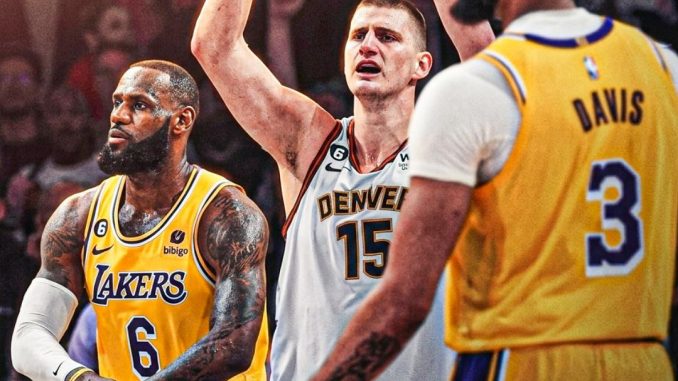
Three years ago, the Western Conference belonged entirely to Nikola Jokić, and the moment the Denver Nuggets closed out the Los Angeles Lakers in a clean sweep of the Western Conference Finals, it felt less like the end of a series and more like the coronation of a new NBA force.
On that unforgettable night, Jokić delivered a masterclass that has since been etched into playoff lore: a 30-point triple-double that powered the Denver Nuggets past the Los Angeles Lakers and into the NBA Finals with ruthless efficiency. It was the kind of performance that didn’t just win a game—it sealed a sweep, reshaped narratives, and reinforced a truth the league was slowly coming to accept: the Nuggets were no longer a rising team. They had arrived.
The stage was the 2023 Western Conference Finals, a collision of contrasting basketball identities. On one side stood the Lakers, a franchise defined by championship expectations, star power, and the looming presence of LeBron James and Anthony Davis. On the other side stood Denver, a team built around a once-in-a-generation center whose brilliance defied traditional scouting reports and positional definitions. At the heart of it all was Jokić, the unassuming Serbian superstar whose game operates in a realm few defenders can fully decode.
From the opening tip of the series, Denver dictated terms. They didn’t just beat the Lakers—they controlled the rhythm of every possession, every matchup, every adjustment. And by the time Game 4 arrived, the sweep felt less like a possibility and more like an inevitability.
Still, nobody expected the final act to be delivered with such clinical artistry.
Jokić, who has never been one to chase spectacle for its own sake, instead delivered inevitability. Every pass seemed pre-loaded with foresight. Every rebound felt like a prediction fulfilled. Every basket came not from explosion, but from geometry, patience, and relentless reading of defensive intentions.
By the time the final buzzer confirmed Denver’s sweep, Jokić’s stat line—30 points, double-digit rebounds, double-digit assists—was almost secondary to the way he achieved it. He dissected the Lakers’ defense like a grandmaster dismantling an overmatched opponent, never rushing, never panicking, always one step ahead.
What made the performance even more remarkable was the context. The Lakers, for all their inconsistencies that season, had found a late-season identity anchored in defensive versatility and star-driven shot creation. They had already eliminated higher-seeded opponents and entered the series believing their size and experience could disrupt Denver’s offensive flow. Instead, they ran directly into a system—and a player—that refused to bend.
Jokić operated as both the engine and the architect. In transition, he pushed the pace not with speed, but with decision-making, hitting cutters before they fully separated, or punishing mismatches before help defense could even rotate. In the half court, he turned every touch into a threat. Double teams arrived a second too late. Single coverage was simply an invitation.
The Lakers tried multiple coverages across the series—switching schemes, zone looks, aggressive hedges—but nothing disrupted the inevitability of Denver’s offensive structure when Jokić was at the center of it. And in Game 4, that inevitability peaked.
It wasn’t just the scoring. It was the orchestration.
Teammates like Jamal Murray thrived in the chaos Jokić created, finding space in the cracks of defensive rotations that were forced to collapse inward. Aaron Gordon became a vertical threat that punished overhelping. Michael Porter Jr. stretched the floor just enough to prevent the Lakers from packing the paint. But all of it traced back to the same source: the gravitational pull of Jokić’s decision-making.
Every possession felt like a chess move that forced Los Angeles into a reactive posture. And the more they reacted, the more openings appeared.
By the third quarter, the Lakers were no longer defending Denver as much as they were surviving them.
Historically, sweeps in conference finals are rarely quiet affairs, but this one carried a different tone. There was no dramatic collapse, no singular turning point that defined the Lakers’ exit. Instead, there was a gradual erosion of options. Each game narrowed the margin of strategic viability until, by the final contest, Los Angeles was simply out of answers.
LeBron James did what he always does in elimination scenarios—fight, adjust, push—but even his brilliance was absorbed into Denver’s collective structure. Anthony Davis delivered strong defensive stretches, but the constant strain of containing multiple actions initiated by Jokić eventually wore down even his impact.
What separated Denver in that series, and especially in the closeout game, was the lack of any exploitable weakness when Jokić was dictating tempo. If the Lakers collapsed the paint, he punished them with precision passing. If they stayed home on shooters, he scored with effortless post footwork and soft-touch finishes. If they switched, he calmly isolated mismatches without forcing anything.
It wasn’t domination through athletic superiority. It was domination through inevitability.
The 30-point triple-double became symbolic not just because of the numbers, but because of the way it reflected his complete control over the game’s ecosystem. He didn’t need 40 points to make his presence overwhelming. He didn’t need highlight-reel sequences to bend the outcome. He simply needed possession after possession where the correct decision consistently flowed through him.
As the final minutes ticked away and Denver’s lead held firm, there was a sense that the series had long since been decided—not in Game 4, but in the cumulative realization that no adjustment could truly slow what Denver had built around its centerpiece.
When the buzzer finally sounded, the Nuggets’ bench erupted, not in shock, but in confirmation. The job had been completed. The sweep was official. And the franchise was heading to the NBA Finals for the first time in its modern era, carrying with it the unmistakable imprint of its leader.
For the Western Conference Finals, the series became a reference point for how a superstar can redefine control in a playoff environment. And for Jokić, it marked another step in the gradual rewriting of what a dominant big man could look like in the modern game.
There are playoff performances that stand out for their explosiveness, others for their drama, and some for their emotional weight. This one stood out for its completeness. There were no gaps in the performance, no lingering moments where control slipped away. Just a steady, relentless application of basketball intelligence that the Lakers simply could not match over four games.
Even years later, the memory of that closeout game lingers because of how calm it felt. Not anticlimactic, but inevitable. Like watching a system reach its final, unavoidable conclusion.
For Denver, it was the moment everything changed. The franchise that had long been dismissed as a regular-season overachiever suddenly stood at the summit of the Western Conference, powered by a player whose game had no historical template.
And for Jokić, it was another entry in a growing catalog of postseason performances that challenge conventional definitions of dominance. He doesn’t overwhelm with speed or explosiveness. He overwhelms with certainty. With control. With a pace that drags the game into his orbit and keeps it there until the final buzzer sounds.
Three years on, that 30-point triple-double in the closeout game remains more than a statistical footnote. It is a reminder of the night Denver didn’t just beat the Lakers—they swept them out of the Western Conference with a kind of quiet authority that only a few teams in NBA history have ever managed.
And at the center of it all stood Jokić, not shouting, not performing, but simply deciding the outcome—one possession at a time.
Be the first to comment