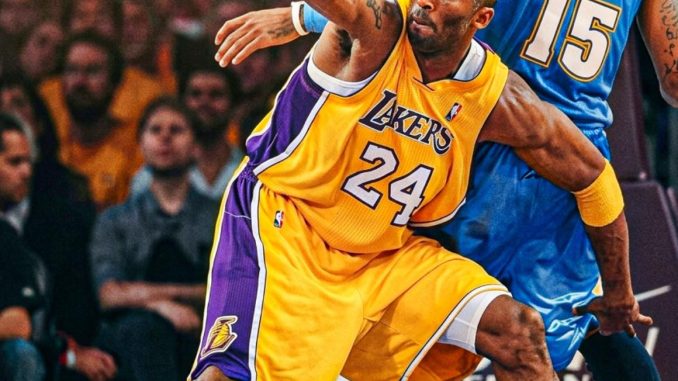
Seventeen years ago today, the basketball world was treated to one of the most physically demanding, emotionally charged, and shot-making-heavy Western Conference Finals duels of the modern era—a six-game war between a championship-tested superstar in Kobe Bryant and a rising offensive force in Carmelo Anthony that felt less like a series and more like a collision of eras, pride, and pure scoring brilliance. The 2009 Western Conference Finals, officially part of the broader 2009 NBA Western Conference Finals, became a defining chapter in both franchises’ modern identities, ultimately ending with the Los Angeles Lakers advancing in six games—but not before Denver pushed them to their absolute limit in a sequence of battles that still echo through NBA playoff history.
From the opening tip, it was clear this was not going to be a routine playoff matchup. The Lakers entered the series as the reigning Western Conference powerhouse, led by Kobe Bryant at the peak of his post-Shaq championship pursuit. Phil Jackson’s triangle offense had matured into a surgical system built around spacing, patience, and late-clock execution, and Los Angeles carried the aura of a team that expected to win championships, not merely compete for them. Across the floor stood a Denver team that had transformed itself midseason into a legitimate contender after acquiring Chauncey Billups, whose leadership and perimeter control elevated the Nuggets from a talented but inconsistent group into a disciplined, confident, and dangerous playoff unit. But the emotional engine of Denver remained Carmelo Anthony, a player whose offensive arsenal was evolving into one of the most unguardable scoring packages in basketball.
What unfolded over six games was a stylistic and psychological clash. Kobe brought surgical footwork, relentless defensive attention, and an almost cruel ability to deliver midrange daggers in rhythm or isolation. Carmelo responded with brute scoring rhythm, physical post-ups, jab-step mastery, and a willingness to embrace contact in ways that tested even the Lakers’ elite wing defenders. Every possession felt like a statement attempt. Every defensive switch felt like a challenge to the opponent’s pride.
Game 1 set the tone immediately. The Lakers established control early, leaning on Kobe’s ability to manipulate Denver’s defensive rotations. He attacked from the elbow, posted smaller guards, and forced double teams that opened up shooters like Pau Gasol and Lamar Odom. Yet Denver refused to fold. Carmelo answered with scoring bursts that kept the Nuggets within striking distance, using his strength to bully his way into high-percentage looks. Even in defeat, Denver signaled they were not intimidated by the moment or the opponent. This was not going to be a sweep, and it was not going to be comfortable.
By Game 2, the Nuggets’ identity began to sharpen. Billups orchestrated the offense with veteran calm, slowing the pace just enough to keep Kobe from turning the game into a transition avalanche. Carmelo thrived in controlled isolation sets, attacking mismatches and forcing the Lakers into constant defensive adjustments. But Kobe, as he so often did in playoff environments, responded not just with scoring, but with psychological pressure. Every Denver run was met with a counter. Every Nuggets highlight was answered with a contested jumper or a drive through contact that felt deflating to the home crowd. The series was no longer about talent alone—it was about will.
When the series shifted to Denver, the altitude and crowd energy amplified everything. Game 3 became one of the defining moments of the matchup. The Nuggets played with urgency, feeding off their home floor and Carmelo’s growing aggression. He attacked early, refused to defer, and embraced the physical tone of the series. Kobe, meanwhile, operated with calculated patience, probing defenses rather than forcing early offense. The contrast was striking: Carmelo as the emotional fire, Kobe as the controlled flame that never burned out.
Game 4 escalated into a full-blown scoring duel. Possession after possession turned into isolation basketball at its purest form. Carmelo Anthony carved out space in the mid-post, punishing smaller defenders and absorbing contact without hesitation. Kobe responded with footwork clinics—fadeaways from the baseline, turnaround jumpers over contested arms, and drives that ended in either finishes or free throws. Neither player was willing to yield momentum. Every bucket felt personal. Every stare down carried weight. By the end of the night, the series was no longer just tied in games or momentum—it was tied in pride.
The turning point of the series, however, came in Game 5. Championship DNA began to assert itself more visibly. Kobe Bryant, sensing the pressure of a tightening series, elevated his defensive intensity and shot selection precision. He began dictating pace rather than reacting to it. The Lakers tightened their rotations, limited Denver’s transition opportunities, and forced Carmelo into more difficult, late-clock shots. While Carmelo still delivered scoring bursts, the efficiency gap started to widen, and that subtle shift became critical. Championship teams do not always win loudly; sometimes they win by narrowing margins until the opponent has nowhere left to go.
Yet Denver was not finished. Game 6 became a testament to resilience and pride. Carmelo Anthony refused to let the series end quietly, attacking early and often, trying to drag the Nuggets back into rhythm. His scoring came in waves—post-ups, pull-up jumpers, and physical drives that tested the Lakers’ interior defense. The Nuggets fed off urgency, knowing elimination brings a different kind of energy, one that removes hesitation and replaces it with instinct.
But Kobe Bryant, as he had done countless times before, answered the call with cold precision. He did not chase the game emotionally; he dissected it. When Denver scored, he responded. When the Nuggets tightened defensively, he adjusted spacing and timing. When the crowd roared, he slowed the game down and forced control back into the Lakers’ hands. It was less about volume scoring and more about control—control of tempo, control of emotion, control of outcome.
The Lakers ultimately closed the series in six games, advancing past Denver and continuing their championship run that would culminate in a title later that season. But the numbers alone do not capture what this series represented. It was a passing of respect between two elite scorers at different stages of their careers. It was Kobe solidifying his legacy as a closer who could impose his will across six grueling games. It was Carmelo Anthony announcing himself not just as a scorer, but as a playoff force capable of pushing the league’s best to the edge.
What made the series endure in memory was not just the outcomes, but the consistency of elite shot-making under pressure. There were no easy nights. There were no relaxed defensive possessions. Every basket required invention, strength, timing, or sheer audacity. Kobe’s footwork became a masterclass in efficiency under duress. Carmelo’s isolation game became a blueprint for how scoring wings could dictate playoff tempo without traditional playmaking structures.
In retrospect, the 2009 Western Conference Finals stands as one of the clearest examples of playoff basketball at its most distilled form—two superstars trading possessions like heavyweights trading rounds, each refusing to blink, each forcing the other into deeper and more creative layers of offense. It was not just Lakers versus Nuggets. It was control versus resistance. It was experience versus emergence. It was precision versus power.
Seventeen years later, the series still holds its place in NBA memory because it represents something increasingly rare in the modern game: sustained, uninterrupted star-driven basketball where adjustments were made not through analytics alone, but through pride, repetition, and pure competitive instinct. Kobe Bryant and Carmelo Anthony did not just play a series—they authored a six-game duel that defined an era of Western Conference basketball and left behind a blueprint for what playoff intensity truly looks like when two elite scorers refuse to concede even an inch.
Be the first to comment